You don’t need a battery. You don’t need to charge it. Yet, a Rolex watch ticks with near-perfect accuracy day after day, year after year. So how does a Rolex watch work? At its core, every modern Rolex is powered by a self-winding mechanical movement, a marvel of micro-engineering that converts the motion of your wrist into stored energy, regulating time with astonishing precision. Unlike quartz watches that rely on electronic oscillators, Rolex timepieces use a symphony of springs, gears, and levers, all working in concert to keep time within ±2 seconds per day.
In this guide, you’ll discover how the Perpetual rotor harnesses motion, how the Chronergy escapement boosts efficiency, and why the Parachrom hairspring resists shocks and magnetism. Whether you’re a watch enthusiast or simply curious about what makes a Rolex tick, you’ll learn how each component, from the balance wheel to the power reserve, works together to create one of the most reliable mechanical movements ever made.
Power Source: No Battery, Just Motion
Rolex watches run on pure mechanics. The vast majority of models use automatic (self-winding) mechanical movements, meaning they generate power from the natural movement of your wrist. The only exception was the discontinued Oysterquartz, which used a battery. But since the 1980s, Rolex has focused entirely on refining mechanical movements, making them more efficient, durable, and precise.
There’s no external charging. No USB cable. Just the simple act of wearing the watch. Every turn of your wrist spins an internal rotor, winding a mainspring that stores energy. That energy is then released in a controlled way to power the watch for up to 70 hours, even when not worn.
How the Perpetual Rotor Generates Power
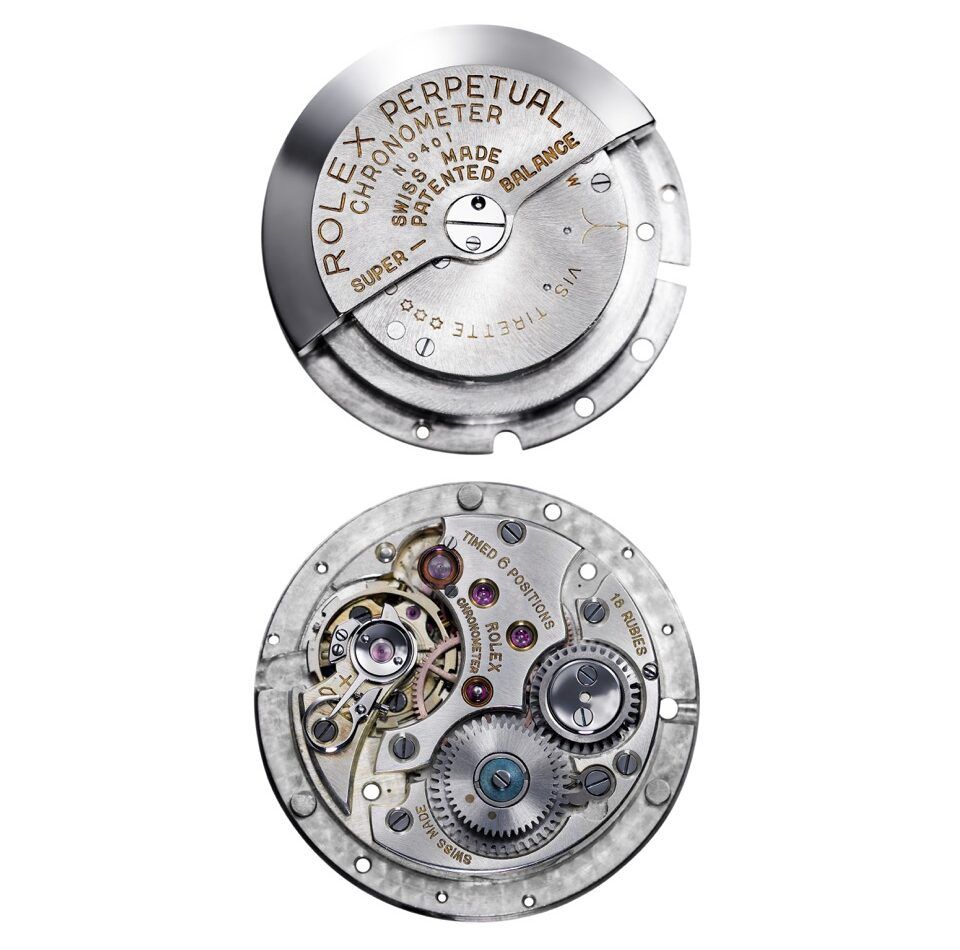
In 1931, Rolex invented the Perpetual rotor, the world’s first practical 360-degree self-winding mechanism. This breakthrough changed watchmaking forever. Before this, automatic watches used limited-swing rotors that only wound in certain directions. Rolex’s design used a center-mounted oscillating weight that spins freely in any direction, ensuring constant winding regardless of arm movement.
Here’s how it works:
• The semi-circular rotor swings with every motion of your wrist.
• Its movement turns a reversing gear system, which converts bidirectional rotation into one-way winding of the mainspring.
• Two Teflon-coated winding wheels (patented in 1952) ensure smooth, wear-resistant operation.
• The rotor operates in constant unstable equilibrium, meaning even the slightest motion contributes to winding.
This is why a Rolex can stay powered for three full days off the wrist, thanks to the efficiency of the Perpetual system. And because the rotor winds in both directions, no energy is wasted.
Energy Storage: Mainspring and Power Reserve
Once the rotor winds the mainspring, that energy must be stored and released steadily. The mainspring is a long, coiled strip of special alloy housed inside the barrel. When wound, it stores potential energy like a compressed spring. As it slowly unwinds, it delivers power to the gear train.
Rolex optimizes this system for maximum efficiency and longevity.
Barrel Design and Slipping Clutch
• The barrel is precision-machined with optimized wall thickness to reduce friction.
• A slipping clutch mechanism prevents over-winding. Once the mainspring is fully wound, it slips harmlessly, protecting the movement.
• This ensures a stable energy flow whether the watch is fully wound or nearing the end of its power reserve.
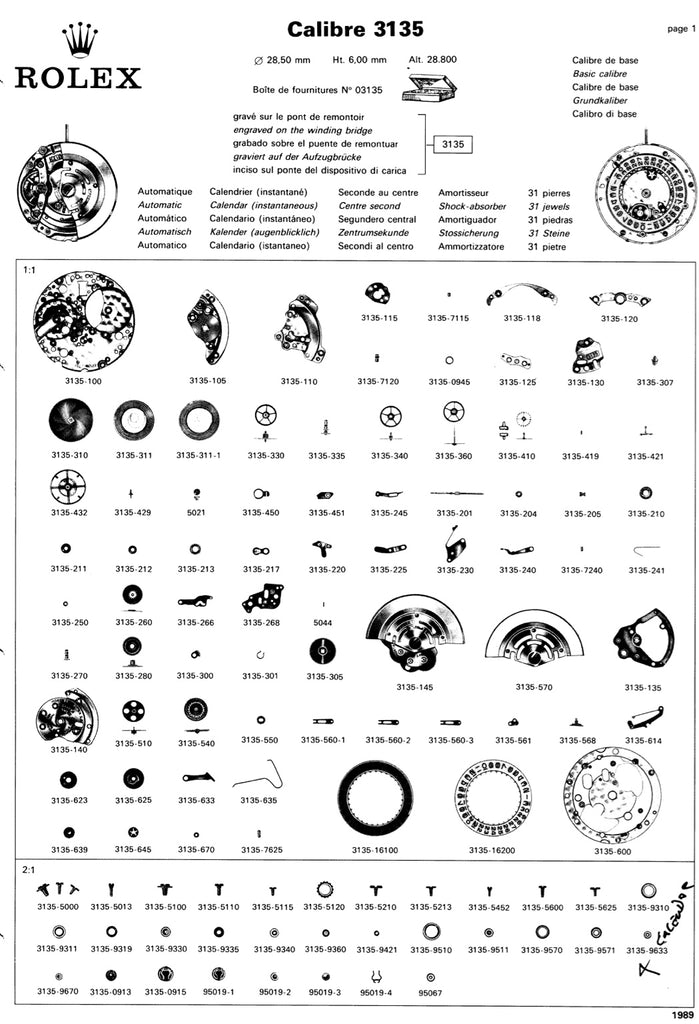
Modern Rolex calibers like the 3235 and 3285 offer 70 to 72 hours of power reserve, far exceeding the traditional 48-hour standard. Older models like the Caliber 3135 still deliver a solid 48 hours.
Gear Train: Transmitting Energy to the Hands
The energy from the mainspring doesn’t drive the hands directly. It travels through a gear train, a series of precisely cut wheels that step down the high torque of the spring into usable motion.
Each gear has a specific role:
• Center Wheel: Rotates once per hour, driving the minute hand.
• Third Wheel: Transfers motion at intermediate speed.
• Fourth Wheel: Rotates once per minute, driving the seconds hand via the escapement.
• Escape Wheel: Delivers energy in precise pulses to the balance wheel.
• Motion Work: A sub-gear train that reduces rotation to turn the hour hand once every 12 hours.
To reduce friction and wear, Rolex uses 31 synthetic rubies (lab-grown corundum) as jewel bearings at pivot points. These aren’t decorative, they’re functional, ensuring decades of smooth operation.
Time Regulation: The Escapement System
If the mainspring is the engine, the escapement is the brake and throttle. It controls how fast energy is released, ensuring the watch keeps accurate time. Rolex calls this the heartbeat of the movement.
Chronergy Escapement (2015–Present)
Introduced in Caliber 3235, the Chronergy escapement is Rolex’s proprietary upgrade to the traditional Swiss lever design.
Key features include:
• Operates at 28,800 vibrations per hour (4 Hz), 8 ticks per second.
• Made with paramagnetic materials, reducing magnetic interference.
• 15% more efficient than previous escapements, contributing to longer power reserve.
• Used in Calibers 3235, 3285, and 3286.
This efficiency allows Rolex to extend power reserve without increasing mainspring size.
Dynapulse Escapement (2025, Caliber 7135)
A revolutionary leap in the Land-Dweller, the Dynapulse escapement uses silicon components for the first time in a Rolex movement.
• Runs at 36,000 vph (5 Hz), 10 beats per second.
• Delivers smoother energy pulses to the balance wheel.
• Improves amplitude stability and long-term accuracy.
• Immune to magnetism and corrosion.
This marks a bold shift toward high-frequency, high-efficiency mechanics.
Precision Oscillator: Balance Wheel and Hairspring
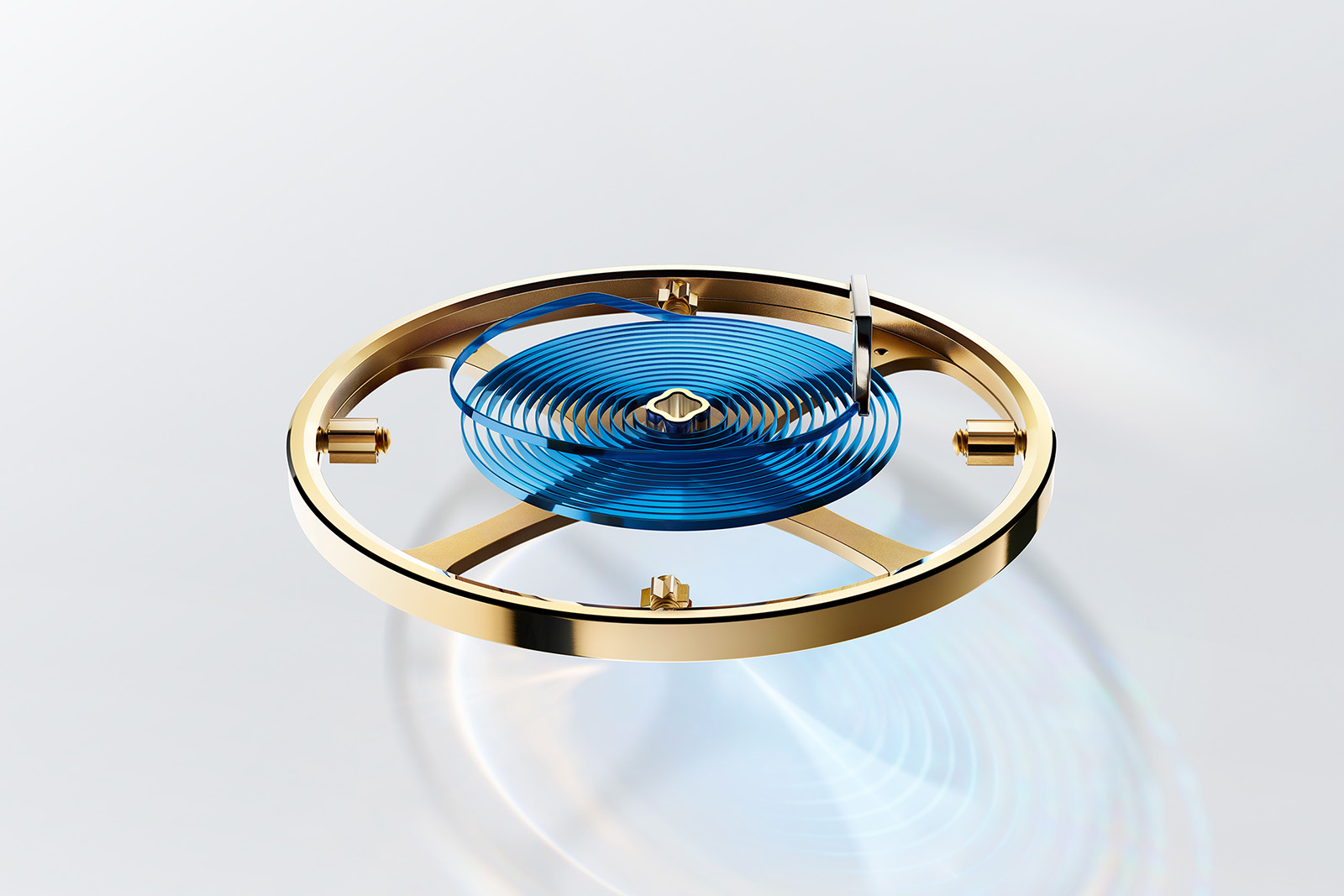
The balance wheel and hairspring are the timekeeping heart of the watch. Together, they oscillate back and forth at a fixed frequency, dividing time into equal segments.
Glucydur Balance Wheel
• Made from beryllium bronze alloy (Glucydur), which resists thermal expansion.
• Maintains accuracy across temperature changes, from Arctic cold to desert heat.
• Fitted with gold Microstella weights for fine-tuning during calibration.
These weights can be adjusted without removing the movement, allowing for precision timing in the finished watch.
Parachrom Hairspring (2005–Present)
Rolex’s Parachrom hairspring is a game-changer in mechanical watchmaking.
• Made from niobium, zirconium, and oxygen, a proprietary alloy.
• Blue color from anodization, preventing oxidation.
• Advantages include 10x more shock resistance than steel, immunity to magnetism, and unaffected by temperature shifts.
Found in most modern Rolex models, it’s a key reason why Rolexes maintain accuracy in real-world conditions.
Syloxi Hairspring (Silicon, 2014–Present)
Used in smaller movements like Caliber 2236 (women’s Datejust), the Syloxi hairspring is made entirely from silicon.
• Lightweight and highly elastic.
• Perfectly isochronous, meaning consistent timing.
• Immune to corrosion and magnetism.
• Requires no lubrication.
Despite its microscopic size, it delivers giant performance in compact, high-precision movements.
Shock Protection: The Paraflex System
Even the most precise watch can fail if dropped. Rolex protects its movements with the Paraflex shock absorber, introduced in 2005.
How Paraflex Works
• Doubles the shock resistance of the balance wheel pivot.
• Uses a dual-action design. First, elastic deformation absorbs impact like a spring. Second, controlled displacement allows slight movement to prevent breakage.
• Responds in milliseconds, neutralizing shocks from drops or knocks.
• 50% more effective than standard systems like Incabloc.
This ensures your Rolex survives daily wear, whether you’re typing, hiking, or traveling.
Precision Adjustment: Microstella Nuts
Rolex doesn’t just build movements, it fine-tunes them. The Microstella nuts on the balance wheel allow for on-the-fly timing adjustments.
• Star-shaped, gold nuts mounted on the rim of the balance wheel.
• Adjusted with a special tool to change the moment of inertia.
• Allows watchmakers to calibrate timing without removing the movement.
• Redesigned in 1983 for greater stability and precision.
The star shape symbolizes Rolex’s philosophy: Aim high to achieve precision.
Chronometer Certification: Superlative Precision
Every modern Rolex is a Superlative Chronometer, Officially Certified.
COSC Testing
• Movement tested for 15 days in 5 positions and 3 temperatures.
• Must keep time within -2 to +2 seconds per day.
• Stricter than standard COSC, which allows -4 to +6 sec/day.
Rolex’s Final Adjustment
After COSC, Rolex performs its own final calibration.
• Often achieves ±1 second per day in real use.
• Each watch receives a red chronometer seal.
This dual certification ensures real-world precision, not just lab performance.
Winding and Setting: How to Use Your Rolex
Even automatic watches need setup after inactivity.
How to Wind an Automatic Rolex
- Unscrew the crown by turning counter-clockwise 3 to 4 times.
- Wind clockwise 30 times until resistance builds.
- Pull to Position 2 to set date, avoiding the hours between 9 PM and 3 AM.
- Pull to Position 3 to set time.
- Push in and screw down crown to maintain water resistance.
Use a watch winder for long-term storage if you don’t wear your Rolex daily.
Complications: More Than Just Time
Rolex integrates complications with a focus on functionality and reliability.
Instantaneous Date Change
• Found in Datejust and Submariner models.
• Date flips instantly at midnight, synchronized with the hour wheel.
• Uses a spring-loaded jumper for crisp transitions.
• Cyclops lens magnifies date by 2.5x for clarity.
Day-Date Display
• Exclusive to the Day-Date model.
• Shows full day names in 26 languages.
• Both day and date change simultaneously at midnight.
GMT-Master II: Dual Time Zone
• Powered by Caliber 3285.
• Independent hour hand adjustment in one-hour jumps.
• 24-hour hand shows second time zone.
• Perfect for travelers.
Chronograph: Cosmograph Daytona
• Equipped with Caliber 4131, an integrated chronograph.
• Features vertical clutch for no hand twitch on start and stop.
• Measures elapsed time with split-second precision.
Annual Calendar: Sky-Dweller
• Automatically adjusts for 30 and 31-day months.
• Only needs one manual correction per year, February to March.
• Uses the Saros mechanism, elegant over complex.
Frequently Asked Questions About Rolex Watch Mechanics
How does a Rolex watch wind itself without a battery?
A Rolex watch uses a Perpetual rotor, a semi-circular weight that swings freely with your wrist motion. This rotor turns a reversing gear system that winds the mainspring bidirectionally, storing energy for up to 70 hours. The system works in any direction, so normal arm movement keeps the watch wound continuously.
What is the power reserve of a modern Rolex?
Modern Rolex calibers like the 3235 and 3285 offer 70 to 72 hours of power reserve. Older calibers like the 3135 provide 48 hours. This means you can take your Rolex off Friday night and put it back on Sunday morning, and it will still be running perfectly.
How accurate is a Rolex compared to other watches?
Rolex requires COSC certification of -2 to +2 seconds per day, which is stricter than the standard COSC allowance of -4 to +6 seconds per day. In real-world use, many Rolexes achieve ±1 second per day accuracy thanks to Rolex’s own final adjustments.
What makes the Parachrom hairspring special?
The Parachrom hairspring is made from a proprietary alloy of niobium, zirconium, and oxygen. It offers 10 times more shock resistance than traditional steel hairsprings, is immune to magnetism, and maintains stability across temperature extremes. This ensures your Rolex keeps accurate time even in harsh conditions.
Can a Rolex survive being dropped?
Yes, thanks to the Paraflex shock absorber system introduced in 2005. It provides 50% more shock resistance than standard systems by using dual-action elastic deformation and controlled displacement. This protects the balance wheel and escapement from everyday impacts.
Do all Rolex watches have mechanical movements?
Almost all modern Rolexes use mechanical movements. The only exception was the Oysterquartz, discontinued in the early 2000s. Every current model, from Submariner to Datejust to Daytona, uses the self-winding Perpetual mechanical movement.
Key Takeaways for Understanding How a Rolex Watch Works
A Rolex watch works through a seamless fusion of motion, mechanics, and innovation. From the Perpetual rotor that captures your wrist’s movement to the Parachrom hairspring that resists shocks and magnetism, every component is engineered for precision, durability, and longevity.
The heart of a Rolex lies in its mechanical movement, where energy flows from the mainspring through the gear train to the escapement, which regulates time with heartbeat-like precision. The Chronergy escapement boosts efficiency by 15%, while the Paraflex system protects against impacts. Together, these innovations ensure your Rolex maintains ±2 seconds per day accuracy, surpassing already stringent COSC standards.
Whether you’re wearing a Submariner, Datejust, GMT-Master II, or Daytona, you’re not just telling time. You’re carrying a masterpiece of mechanical intelligence on your wrist, engineered to last generations.