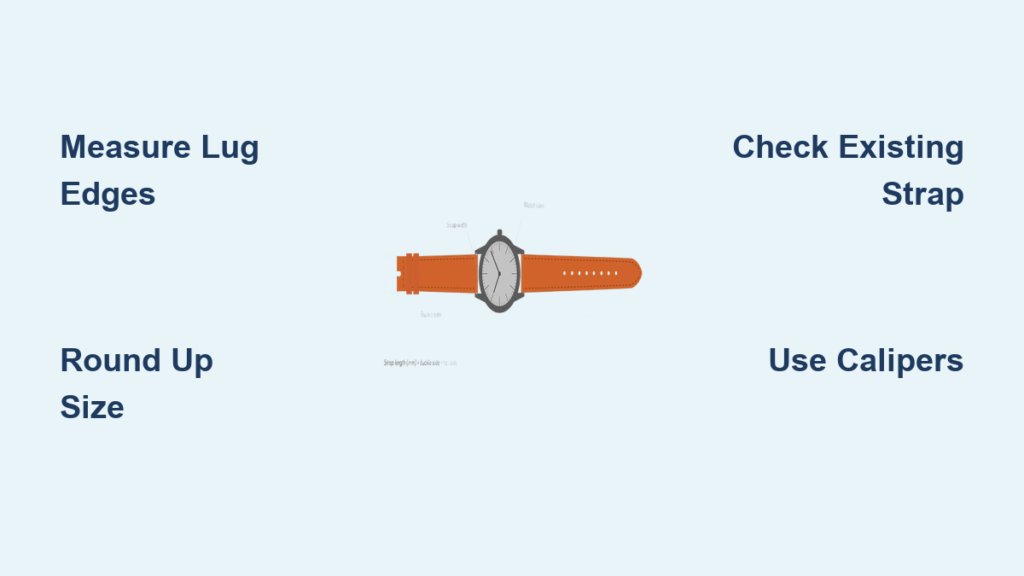
Choosing the right watch strap isn’t just about style. It’s about fit, function, and protecting your timepiece. The most critical measurement is watch strap width, also known as lug width. This determines whether a strap will attach securely and sit flush against your watch case. A mismatched strap can wobble, gap, or even damage your lugs over time. Whether you’re upgrading to a leather band, switching to a NATO, or replacing a broken bracelet, knowing how to measure watch strap width accurately is essential. In this guide, you’ll learn the precise methods to measure between the lugs, interpret your results, select the correct size, and avoid common fitting mistakes.
Measure Between the Lugs

The most reliable way to determine strap width is measuring directly between the watch lugs. These are the protruding horns on the case where the strap attaches via spring bars. This method gives you the exact internal width your strap needs to fit.
Use Calipers for Precision
Digital calipers deliver the most accurate readings, down to 0.1 mm. This precision matters when your measurement falls between standard sizes.
Steps to measure with calipers:
- Remove the current strap using a spring bar tool or release quick-detach levers if equipped
- Open the caliper jaws and gently insert them between the inner edges of both lugs
- Close the jaws until they make light contact with both sides
- Read the measurement in millimeters
- Repeat to confirm consistency
Pro Tip: If your reading is 19.8 mm or higher, round up to 20 mm. Straps are only manufactured in whole millimeter sizes.
Use a Ruler as Backup
No calipers? A millimeter ruler works in a pinch. This method is less precise but sufficient for most purposes.
How to measure with a ruler:
- Align the ruler’s zero mark with the inside edge of one lug
- Read the value at the inside edge of the opposite lug
- Ensure the ruler lies flat and straight across the gap
- Take the measurement twice for accuracy
Warning: Avoid inch-based rulers unless converting precisely. One inch equals 25.4 mm, and conversion errors lead to wrong sizes.
Check an Existing Strap
If your current strap fits well, it can serve as your measuring reference. This is often the fastest way to determine your lug width without removing anything.
Look for Stamped Size Markings
Flip the strap over. Many leather, rubber, and silicone straps have the width stamped near the lug end. Look for numbers like “20” or “20mm” printed on the underside.
Common locations for markings:
- Underside of the strap near the spring bar hole
- Inside the leather lining
- Near the buckle on some models
Found a number? That’s your lug width. This is the easiest way to measure watch strap width when markings are present.
Measure the Lug End Directly
If your strap has no labels, measure the attachment end directly. Lay the strap flat and measure the widest part that connects to the watch.
Steps to measure the lug end:
- Use calipers or a ruler
- Measure the widest part of the attachment end
- Ignore the buckle end since many straps taper toward the clasp
Caution: A 22 mm strap may measure 21.7 mm due to manufacturing tolerance. This is normal and still fits a 22 mm lug properly.
Interpret Your Measurement
Strap widths are sold in whole millimeters. No half-sizes exist in the market. Understanding how to interpret your measurement ensures a snug, gap-free fit every time.
Round Up Fractional Sizes
Always round up to the nearest full millimeter. This prevents the strap from being too loose.
Examples of rounding:
- 19.6 mm becomes 20 mm strap
- 21.2 mm becomes 22 mm strap
- 18.4 mm becomes 19 mm strap
Critical warning: Never round down. A 19 mm strap won’t fit a 19.5 mm gap properly and will wobble.
Know Standard Width Increments
Most straps come in 2 mm increments, though this is changing.
Common sizes:
- 18, 20, 22, 24 mm are the most widely available
- 16 and 26 mm exist for small or oversized watches
- 19, 21, 23 mm are growing in popularity, especially for vintage-style models
Example: A Rolex Submariner uses 20 mm on older models or 21 mm on newer versions. Always verify your specific model.
Verify with Popular Model Chart
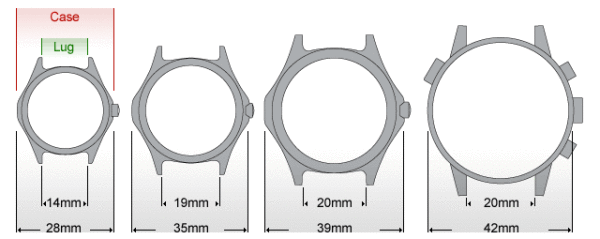
When in doubt, check known lug widths for major watch brands. This reference helps confirm your measurement and prevents ordering errors.
| Watch Model | Lug Width (mm) |
|---|---|
| Apple Watch 38/40mm | 22 |
| Apple Watch 42/44mm | 24 |
| Grand Seiko Snowflake | 20 |
| Omega Speedmaster | 20 |
| Tudor Black Bay | 22 |
| Rolex Datejust | 20 |
| Breitling Navitimer | 22 |
| IWC Pilot’s Watch | 20 |
Apple Watch tip: Straps are cross-compatible by size across Series 1 through 9, SE, and Ultra models. However, 38mm and 40mm cases require different straps than 42mm and 44mm cases.
Match Width to Case Diameter
A strap should balance visually with the watch case. The right proportions make your timepiece look cohesive and professional.
50% Rule for Proportional Fit
Strap width should roughly equal half the case diameter. This creates visual harmony whether you’re wearing a dress watch or a dive tool.
| Case Size (mm) | Recommended Strap Width (mm) |
|---|---|
| 36 | 18 |
| 38 | 19 |
| 40 | 20 |
| 42 to 44 | 21 to 22 |
| 48 | 24 |
Example: A 40 mm dive watch looks best on a 20 mm strap. A 44 mm tool watch suits 22 mm widths.
Consider Wrist Size and Style
Your wrist circumference and fashion preference influence the ideal strap width. Matching these factors ensures both comfort and visual appeal.
Slim Wrists (15 to 17 cm)
Narrower straps prevent the watch from overwhelming your wrist. These sizes work best for dress watches and vintage designs.
Best for slim wrists:
- 18 to 20 mm straps
- Dress watches with thin cases
- Formal leather straps
Average to Large Wrists (17 to 20 cm)
This range accommodates most strap widths comfortably. You can pull off both classic and sporty looks.
Ideal for average wrists:
- 20 to 22 mm straps
- Sports and field watches
- NATO or rubber bands
Large Wrists (20+ cm)
Larger wrists support wider straps for a proportional appearance. The added width balances the visual weight of both case and strap.
Perfect for large wrists:
- 22 to 24 mm straps
- Oversized diver cases
- Metal bracelets
Choose Tapered vs. Straight Straps

Strap shape affects comfort and visual elegance. Understanding tapering helps you select the right style for your watch and lifestyle.
What Is Tapering?
A tapered strap narrows from lug to buckle. Manufacturers label this as X/Y mm, where X represents lug width and Y represents buckle width.
Examples of tapered straps:
- 22/20 mm means 22 mm at lugs, 20 mm at buckle
- 20/18 mm means 20 mm at lugs, 18 mm at buckle
Benefits of Tapering
Tapered straps offer several advantages that improve both function and style.
Key benefits:
- Sleeker transition from case to wrist
- Less bulk under shirt cuffs
- Better drape on curved wrists
When to Use Each Type
| Style | Best Strap Type |
|---|---|
| Dress watch | Tapered (20/18 mm) |
| Dive watch | Straight (22/22 mm) |
| NATO strap | Straight or slight taper |
| Formal leather | Subtle taper (1 to 2 mm difference) |
Pro Tip: Tapering enhances elegance while straight straps offer rugged durability for tool watches.
Use the Right Measuring Tools
Precision starts with the correct tool. Using proper equipment eliminates guesswork and ensures accurate measurements every time.
Digital Calipers (Best Accuracy)
Digital calipers measure to 0.1 mm precision. This level of accuracy matters when verifying tight fits between your lugs and potential straps.
Why calipers are worth it:
- Measures to 0.1 mm accuracy
- Ideal for verifying exact fit
- Reusable for future projects
Investment: Available for under $15 online, making this a worthwhile addition to any watch owner’s toolkit.
Millimeter Ruler (Budget Option)
A millimeter ruler works when budget or availability is a concern. This tool is found in most household toolkits.
Using a ruler effectively:
- Use edge markings for alignment
- Measure multiple times for consistency
- Keep the ruler flat against the surface
Avoid: Soft measuring tapes that stretch and skew results.
Printable Templates (Alternative)
Some brands offer free PDF measurement guides. Print at 100% scale and align with your lugs to read width visually.
Brands offering templates: Carl Friedrik, Nixon, and other premium strap makers provide these resources.
Measure Strap Length Correctly
Width ensures attachment compatibility. Length ensures comfort on your wrist. Both measurements matter for the perfect fit.
Understand Length Format
Watch strap length appears as X/Y mm format. The first number represents the longer tail side at 6 o’clock, and the second number represents the shorter buckle side at 12 o’clock.
Example: A 130/80 mm strap has a 130 mm tail and 80 mm buckle side.
Measure Your Wrist
- Wrap a soft tape or paper strip around your wrist bone
- Mark where it overlaps cleanly
- Measure the length in millimeters
Use this chart to match your wrist size:
| Wrist Circumference | Suggested Strap Length |
|---|---|
| 150 to 164 mm (6 to 6.5 inches) | 120/70 mm |
| 165 to 178 mm (6.6 to 7.0 inches) | 125/75 mm |
| 179 to 190 mm (7.1 to 7.5 inches) | 130/80 mm |
| 191 to 203 mm (7.6 to 8.0 inches) | 135/85 mm |
| 204 to 216 mm (8.1 to 8.5 inches) | 140/85 mm |
| 217 to 229 mm (8.6 to 9.0 inches) | 145/90 mm |
Tip: If between sizes, choose the longer option. You can always adjust holes, but you cannot add length.
Avoid Common Measurement Mistakes
Even small errors lead to ill-fitting straps. Avoiding these pitfalls saves money and frustration.
Mistake: Measuring Outside the Lugs
Measuring from outer edge to outer edge gives a larger number than your actual lug width. This error causes you to order straps that are too wide.
Correct method: Always measure between inner edges of the lugs.
Mistake: Ignoring Taper
Measuring the buckle end of a tapered strap gives a false reading. The buckle is always narrower than the attachment point.
Correct method: Always measure the lug end where the strap connects to the watch.
Mistake: Forgetting Spring Bar Clearance
Some straps require standard spring bars while others need curved versions. Using the wrong type causes the strap to lift at one end.
Visual cue: If the strap lifts at one end, the spring bar may be too short or the wrong shape for your lugs.
Final Tips for Perfect Fit
These additional pointers help ensure your next strap purchase fits perfectly the first time.
Before buying:
- Measure twice and order once
- Cross-reference with manufacturer specifications or watch forums
- Save your watch’s lug width in your phone’s notes app for future reference
Testing options:
- Buy sample packs from retailers who sell strap samplers (multiple widths in one package)
- This lets you test actual fit before committing to a specific material
Material considerations:
- Thick leather or metal may press against lugs if clearance is tight
- Opt for slimmer profiles if your measurement shows less than 2 mm clearance
Key Takeaways for Measuring Watch Strap Width
Measuring watch strap width is quick, simple, and essential for any watch enthusiast. Use digital calipers or a millimeter ruler to measure between the inner lug edges in millimeters. Round up to the nearest whole millimeter and verify with model charts when unsure. Pair correct width with proper length and appropriate taper for a flawless fit. With these steps, you’ll confidently upgrade your watch’s look and comfort every time you shop for a new strap.
Frequently Asked Questions About Measuring Watch Strap Width
What is the difference between lug width and strap width?
Lug width and strap width refer to the same measurement. Both terms describe the distance between the inner edges of the watch lugs where the strap attaches. This is the critical dimension for strap compatibility.
Can I use a regular tape measure to measure watch strap width?
Avoid using fabric tape measures as they stretch and give inaccurate readings. Use digital calipers for precision or a rigid millimeter ruler for adequate accuracy. If using a tape measure, the stretch can cause errors of 1 mm or more.
How do I measure a watch strap width without removing the current strap?
You can measure directly between the lugs using calipers or a ruler placed across the case. Alternatively, check your existing strap for stamped size markings on the underside near the lug connection point.
What happens if I buy the wrong width strap?
A strap that’s too narrow will wobble and may fall off. A strap that’s too wide won’t fit through the lugs at all or will create visible gaps. Both scenarios damage the watch’s appearance and potentially the lugs over time.
Do all watch brands use the same width increments?
Most manufacturers follow 2 mm increments (18, 20, 22, 24 mm), but some vintage and specialty brands use 1 mm increments (19, 21, 23 mm). Always measure your specific watch rather than assuming standard sizing.
How accurate does my measurement need to be?
Aim for accuracy within 0.5 mm. Since straps only come in whole millimeter sizes, measuring precisely lets you round correctly. If you’re between sizes, always round up to ensure a snug fit.