Opening the case back of a Rolex watch is not like servicing a typical timepiece. Rolex’s Oyster case design is engineered for durability, precision, and water resistance up to 390 meters in some models. This means the case back is screw-down, not snap-on, and requires specialized tools and expertise to remove safely. Attempting to open it without proper knowledge or equipment risks permanent damage, voids the warranty, and can compromise the watch’s performance and value.
If you’re considering opening your Rolex for service, battery replacement on vintage Oysterquartz models, or authenticity verification, you need to understand the risks, tools, and professional standards involved. This guide walks you through everything from official procedures used by Rolex technicians to user-reported DIY methods, their effectiveness, and why most experts strongly advise against amateur attempts.
Use the Right Rolex Case Back Tool

Opening a Rolex is not about brute force. It is about precision. The fluted edge on the case back is designed to interface only with exact-fit tools. Using improvised methods often leads to slippage, scratches, or irreversible damage.
Choose the Correct Die Size
Rolex case backs feature a notched or toothed perimeter that requires a matching precision die. These dies come in specific metric sizes.
- 26.5mm: Fits most standard Rolex models including Submariner, Datejust, GMT-Master II, and Explorer.
- 28mm: Used for larger cases like the Deepsea or certain Day-Date versions.
Even a 0.1mm mismatch can cause the tool to skip teeth, leading to stripped fluting. This is a costly repair that diminishes collectibility.
Pro Tip: Measure your case back’s outer diameter with calipers before purchasing a die. Never guess.
Invest in a Quality Wrench and Dies
The best tool for the job is a T-handle or L-shaped case back wrench paired with interchangeable hardened steel dies. The Bergeon 6598 Set is the industry standard, trusted by professionals worldwide. Dies must be clean, undamaged, and fully engage all flutes before turning. Avoid cheap Amazon sets. Poor tolerances increase slippage risk.
Secure the Watch Properly
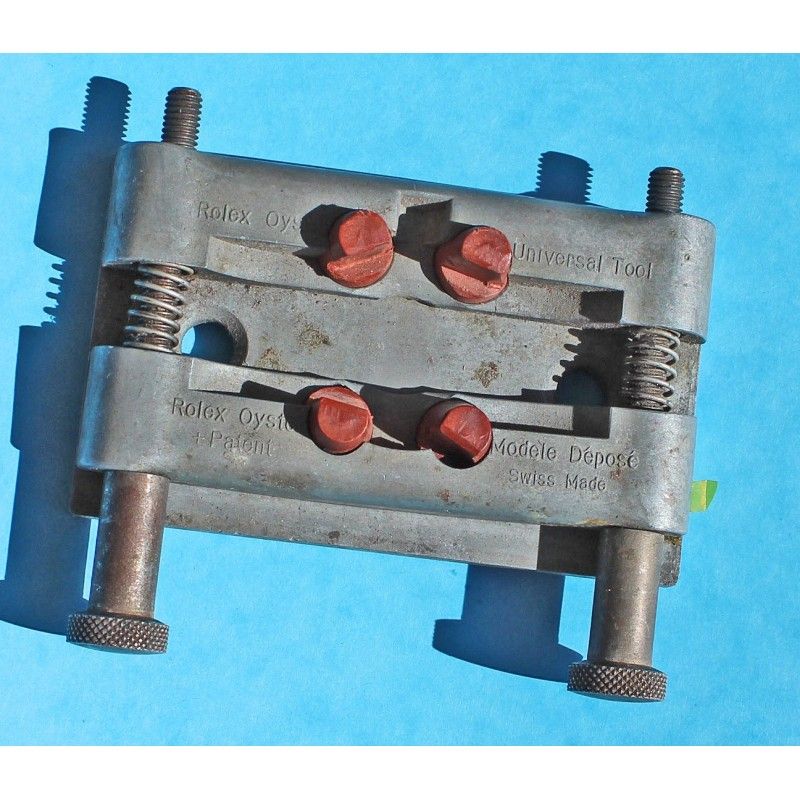
Never hold the watch in your hand while applying torque. One slip could damage the crystal, crown, or lugs.
Use a Padded Watch Holder or Movement Vice
A non-marring watch case holder keeps the case stable while you turn the back. This prevents rotation and protects polished surfaces.
- Clamp gently. Over-tightening can deform soft gold cases.
- Position the watch face-down on a microfiber pad inside the vice.
- Ensure no pressure touches the bezel or crystal.
This step is non-negotiable in professional settings and should be followed even during DIY attempts.
Open Counterclockwise with Controlled Force
The Rolex case back screws in clockwise and comes off counterclockwise. But do not rush it.
Break the Seal Safely
Many case backs are secured with a light thread lock or factory lubricant, making initial rotation stiff. Instead of forcing it, watchmakers use a rocking technique.
Watchmaker’s Rocking Technique: Apply slight clockwise pressure, then reverse to counterclockwise. Repeat gently to break the seal without shock loading.
- Use smooth, steady motion. Do not jerk.
- Maintain downward pressure on the die to prevent disengagement.
- If resistance persists, stop. Forcing it risks stripping the case back threads.
Try the Rubber Ball Method
For those unwilling to invest in tools, the rubber ball method is the least invasive DIY option. It is surprisingly effective in some cases.
How It Works
A slightly tacky rubber ball uses friction to grip the fluted edge when pressed firmly and rotated counterclockwise.
Step-by-Step
- Place the watch face-down on a soft surface.
- Hold the case steady with one hand.
- Press the ball into the center of the case back.
- Rotate counterclockwise with firm, even pressure.
User Feedback
- “The Bergeon ball worked like magic.” — Even_Freedom_348
- “I used my dog’s glow-in-the-dark toy ball. No issues.” — Charming_Public_7145
- “Old 8008 ball didn’t budge mine.” — Wayne Zav
Note: Success depends on ball freshness and case tightness. Works best on older or loosely tightened backs.
Limitations
- Fails on over-torqued, corroded, or tightly sealed units.
- High risk of dropping the watch if not stabilized.
- No control during reassembly means risk of over-tightening.
Avoid Tape and Pen Hacks
Some online guides suggest duct tape and a pen as a lever arm. While technically possible, this method is risky and unprofessional.
Why It Is a Bad Idea
- Tape leaves residue on polished cases.
- Uneven grip causes sudden slips, potentially injuring fingers or damaging the watch.
- Impossible to apply consistent torque.
Not recommended for any valuable or collectible Rolex.
Emergency Option: Superglue a Nut
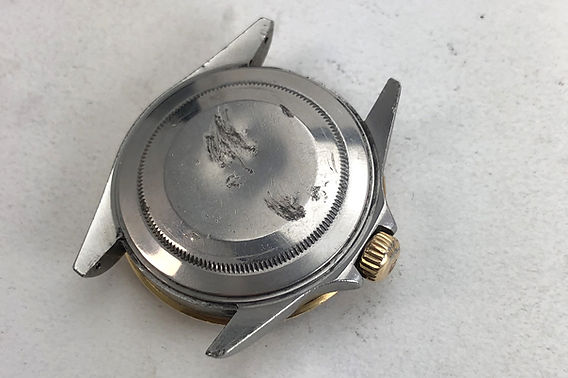
When all else fails, experienced watchmakers sometimes resort to gluing a metal nut to the case back.
When to Consider This
- Case back is seized due to corrosion or over-torquing.
- Professional tools are unavailable.
- The watch is already out of warranty and needs servicing anyway.
Steps
- Tape around the case edge to protect against glue overflow.
- Apply cyanoacrylate glue to a flat-sided 12mm nut.
- Press firmly onto the center of the case back.
- Wait 8–12 hours for full cure.
- Use a small wrench to turn the nut counterclockwise.
- Remove residue with acetone and a wooden stick.
Endorsed by watchmakers like Michael Pett and Peter Lau, but only as a last resort.
Risks
- Glue seepage into movement or threads.
- Permanent surface alteration.
- Difficult cleanup.
Inspect the Gasket and Threads
Once open, never ignore the condition of internal components.
Check the Rubber Gasket
Look for these signs of wear.
- Cracks
- Dryness
- Flattening
- Deformation
If worn, replace it with an OEM Rolex gasket. Never reuse an old one.
Clean the Threads
Use a soft brush to remove dust or old lubricant from both the case back threads and the mid-case mating surface. Dirt or debris prevents proper sealing and compromises water resistance.
Reassemble with Care
Putting it back together is just as critical as opening it.
Hand-Tighten First
- Start screwing by hand to avoid cross-threading.
- Rotate smoothly. Any resistance means stop and recheck alignment.
Finish with a Torque Wrench
Rolex does not publish official torque specs, but professionals estimate 15–25 kgf·cm depending on model.
- Under-tightening leads to water ingress.
- Over-tightening strips threads or damages the gasket.
Best Practice: Use a calibrated torque wrench for consistency.
Pressure Test After Reassembly
Water resistance is not assumed. It must be verified.
Required Equipment
- Watch Crystallizer
- Heinrichs Weikmann Vacu-Check
- Or equivalent vacuum or overpressure tester
Testing Process
- Place watch in chamber and create a vacuum.
- Monitor for condensation or bubble formation.
- Perform overpressure test to simulate depth.
Without testing, you have no guarantee of water resistance, even if it feels tight.
This step is mandatory at Rolex Service Centers and should never be skipped.
Never Open an Under-Warranty Rolex
Warranty Is Voided Immediately
Rolex tracks service history and inspects for signs of tampering.
- Tool marks on case back
- Non-OEM gaskets
- Replacement movements
- Refinished parts
If detected, warranty coverage ends instantly and future service may be denied.
Even successful DIY work can cost thousands in lost protection.
Why Most Owners Should Avoid DIY
Despite viral videos and forum success stories, opening a Rolex is not a beginner-friendly task.
Real Risks Include
- Stripped case back: Repair costs exceed $500.
- Movement contamination: Dust or moisture ruins lubrication.
- Loss of value: Collectors avoid watches with evidence of amateur work.
- No battery benefit: Only vintage Oysterquartz models need battery changes.
Bottom Line: For 99% of owners, the safest choice is to take it to a professional.
Visit a Certified Watchmaker Instead
Choose One of Two Paths
Authorized Rolex Service Center
- Factory-trained technicians
- Genuine parts and tools
- Full service includes cleaning, regulation, and pressure testing
- Cost: $500–$1,000 USD
Certified Independent Watchmaker
Look for these qualifications.
- Rolex-specific experience
- Access to OEM gaskets
- Pressure testing equipment
- Client reviews and transparency
Both options preserve value, ensure accuracy, and maintain water resistance.
Alternatives to Opening the Case
Want to verify authenticity or admire the movement? There are safer ways.
Non-Invasive Checks
- Serial number lookup: Match against Rolex database through a dealer.
- Hallmarks and engravings: Use a 10x loupe to inspect case back markings.
- Weight and sound: Genuine Rolexes have distinct heft and rotor noise.
- Dial details: Font, spacing, and alignment are hard to fake.
For Movement Viewing
- Schedule a service and ask the watchmaker to show you the internals.
- Consider buying a watch with a display back like Omega or Tudor Black Bay.
Maintain Long-Term Reliability
A properly serviced Rolex can run accurately for decades.
Service Every 8–10 Years
Rolex recommends periodic maintenance to replace worn gaskets, clean and re-lubricate the movement, regulate timing, and test water resistance. Skipping service leads to internal wear, magnetization, or failure.
Regular care preserves both function and resale value.
Final Verdict: Leave It to the Pros
While methods like the rubber ball or superglue nut trick work in emergencies, they are far from safe or reliable for routine use. The overwhelming consensus among watchmakers is clear.
Opening a Rolex case back is not a DIY project.
This is not just about tools. It is about respecting the engineering of a timepiece built to last generations. Every turn of the case back affects water resistance, structural integrity, and long-term performance.
If you need the case opened for service, repair, or inspection, take it to an authorized Rolex service center or a certified independent watchmaker. They have the training, tools, and accountability to do it right.
Your Rolex deserves nothing less.
Frequently Asked Questions About Opening a Rolex Watch Back
Will opening my Rolex void the warranty?
Yes. Any evidence of case back removal by unauthorized personnel immediately voids the Rolex manufacturer warranty. Rolex tracks service history and will not honor claims if tool marks, non-OEM gaskets, or signs of tampering are found.
Can I open my Rolex to see if it is real?
No. Attempting to open the case back risks damage and voids the warranty. Authentication should be performed externally by a certified dealer or appraiser using serial number verification, dial details, weight analysis, and movement sound.
What happens if I damage my Rolex trying to open it?
Repairs can be extremely expensive. Possible consequences include a stripped case back requiring refinishing or replacement, a damaged movement needing full overhaul, loss of resale value and collectibility, and no warranty coverage for DIY-related damage.
How often should a Rolex be opened for service?
Rolex recommends servicing approximately every 10 years, though environmental exposure from saltwater, humidity, or magnetism may necessitate earlier attention.
What is the safest DIY method for opening a Rolex case back?
The rubber ball method is the least invasive DIY option. It uses a slightly tacky rubber ball pressed firmly against the case back and rotated counterclockwise. However, it only works about 60–80% of the time and carries significant risks. Professional tools remain the only reliable approach.
Can I adjust my Rolex bracelet myself?
You may operate the clasp freely. However, resizing the bracelet requires removing links and should be done by a professional to avoid damaging pins or alignment.