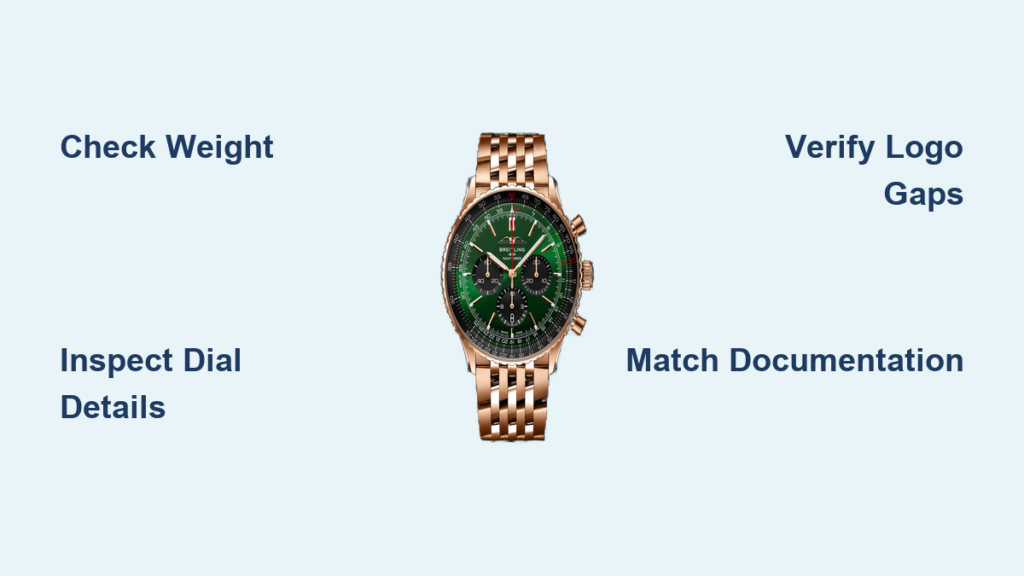
You have found a stunning Breitling watch online or at a pawn shop. The seller claims it is authentic, and the price seems too good to pass up. But how can you be certain? Knowing how to tell if a Breitling watch is real before you buy is essential because counterfeiters have become increasingly sophisticated. This guide walks you through exactly what to examine, what to avoid, and how to verify authenticity with confidence.
Breitling has built its reputation on precision, durability, and professional-grade engineering. Every genuine piece uses premium materials like 316L surgical stainless steel or 18-karat gold, features COSC-certified movements, and undergoes strict quality control. Fakes may look convincing, but they always fall short in key areas: weight, dial details, logo accuracy, functionality, and documentation. Keep reading to learn the specific details that separate a real Breitling from a counterfeit.
Check the Weight and Build Quality

A genuine Breitling has substantial weight due to its construction from premium materials. If the watch feels light or flimsy, you are likely looking at a fake.
Feel the Heft of Authentic Materials
Real Breitling watches are made from 316L surgical stainless steel, 18-karat gold, platinum, or ceramic. These materials give the watch a dense, solid feel on the wrist.
Authentic watches feel balanced and substantial. Counterfeiters often use pot metal or plastic cores under thin plating to mimic the look of luxury materials. A fake watch will feel hollow, unusually cold, or overly warm to the touch, indicating base metal beneath the surface finish.
Inspect the Surface Finish
Genuine Breitling crystals feature anti-reflective coating that gives them a bluish or purplish tint under bright light. This coating reduces glare and improves legibility, which is critical for pilot and dive watches.
Look closely at the crystal surface. Fakes often lack this anti-reflective treatment, resulting in harsh reflections that make the dial difficult to read. Some high-end replicas may simulate the tint, but it is usually uneven or overly glossy. Also check for PVD or DLC coatings on newer models. These finishes should be uniform and chip-resistant, not patchy or peeling.
Examine the Dial for Precision

The dial is one of the easiest places to spot a fake because counterfeiters frequently make mistakes with printing quality and alignment.
Analyze Font, Alignment, and Printing
On a genuine Breitling, all text is sharply printed with consistent font and perfect alignment. Numerals, sub-dial labels, and the word “Chronomètre” are deeply etched or machine-applied.
Use a loupe to examine the dial closely. If the printing looks flat, blurry, or misaligned, that is a major red flag. Look for any smudging, bleeding, or pixelation under magnification. Genuine Breitling dials are machine-embossed with crisp precision that no counterfeit can perfectly replicate.
Verify the Calendar Window
Most Breitling chronographs show only the date or day-date in the window at 3 or 4 o’clock. The numerals should be large, bold, and black, completely filling the aperture.
If your watch displays days of the week, months, or years in the window, it is definitely not authentic. Any additional calendar functions beyond date or day-date on standard models mean you are looking at a fake.
Confirm Standard Chronograph Sub-Dials
Authentic Breitling chronographs always follow a three-sub-dial standard that tracks elapsed time with precision.
Verify the 60-30-12 Layout
Genuine Breitling chronographs feature three specific sub-dials. The 60-second counter sits at 9 o’clock, the 30-minute recorder at 12 o’clock, and the 12-hour totalizer at 6 o’clock.
Counterfeit watches often deviate from this standard. Watch for 7-hour dials, 90-second minute counters, or days of the week appearing in sub-dials. Any unusual labeling or non-standard timing units is a dead giveaway that the watch is not authentic.
Inspect the Logo Details
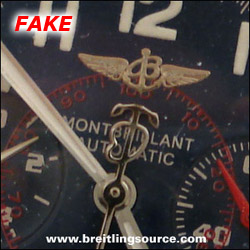
The Breitling logo is a masterpiece of micro-engineering, and counterfeiters frequently miss subtle details that reveal a fake.
Winged Anchor Logo: Spot the Gaps
The Breitling winged anchor logo appears on the dial, caseback, and clasp. On a genuine watch, there is a small gap between the anchor and each wing. On fakes, these elements often touch.
Also examine the inner curve of the wing. A real Breitling has clear space between the inner arc and outer edge. On fakes, lines run edge-to-edge, creating a filled appearance. The logo should be crisp and deeply engraved in all locations.
Cursive B on Heritage Models
Heritage series watches feature a cursive B that is a metal appliqué, not painted or flat-printed. It is raised and three-dimensional, with etched Breitling text below.
Touch it lightly to check for tactile depth. A real Heritage logo feels raised and distinct. A fake will feel smooth and flat, like a sticker.
Review Caseback Engravings
Every genuine Breitling caseback has deep, clean engravings that reveal critical information about the watch.
Decode the Markings
Flip the watch over and examine the caseback for these essential markings. The model reference number appears first, followed by a serial number with up to 7 digits. Water resistance rating shows the depth rating in meters.
Post-2000 models must have the phrase “Chronomètre officiellement certifié” or Chronometer stamp. Precious metal watches have hallmarks, typically located on the lugs.
Shallow, smudged, or misaligned text indicates a replica. Missing serial numbers or mismatched digits are serious red flags. Real engravings are laser-etched with uniform depth.
Caseback Shape and Design
Most modern Breitlings have a domed caseback with a centered Breitling emblem. Some newer Chronomat models use flatter backs inspired by vintage Navitimers.
The font varies slightly by era, but always looks professional. There are never spelling errors on authentic pieces.
Test the Crown and Pushers
Breitling crowns and pushers are precision-machined from solid metal. Their functionality reveals a lot about authenticity.
Assess Craftsmanship and Fit
Genuine Breitling crowns and pushers feature ridged or domed designs inspired by aircraft cockpit instruments. They are smooth, well-aligned, and sit flush against the case.
Counterfeit pushers are often misshapen, asymmetrical, or made from plastic with metal plating. Check for gaps or wobbling when pressing the pushers. Poor alignment indicates inferior craftsmanship.
Functionality: Quick-Action Chronograph
Press the pushers on a genuine Breitling and notice the instant response. Start, stop, and reset happens immediately with no delay, sponginess, or resistance. The reset returns the hand to perfect zero alignment.
On fakes, pushers feel sticky or loose. The chronograph hand may wobble or jump during operation. The central seconds hand should sweep smoothly and stay centered, not drift off-axis.
Check the 12 O’Clock Marker
Many Breitling models feature a pearl inlay or luminescent dot at the 12 o’clock position.
Look for Perfect Centering
On an authentic watch, the 12 o’clock marker is perfectly centered and flush with the dial. This tiny detail is common in replicas because poor dial assembly often results in slight off-center positioning.
Use 10x magnification to check this detail. Even a slight misalignment visible under magnification indicates a counterfeit.
Verify the Movement and Certification
Every genuine Breitling made since 2000 is COSC-certified. This certification is your assurance of precision.
COSC Chronometer Certification
Real Breitling watches come with a matching Chronometer Certificate that proves the movement passed 15 days of testing in different positions and temperatures. The certificate serial number must match the serial number engraved on the caseback.
If there is no certificate or if the numbers do not match, the watch is likely not authentic. Generic paper with no serial match is a major red flag.
Movement Type: In-House or Modified
Breitling uses in-house calibers like Caliber 01 and Caliber 13, or modified ETA and Sellita movements with Breitling-specific upgrades. All movements are hand-assembled and finely finished.
If you can see the movement through a display back, look for the COSC logo, Swiss Made engraving, and quality finishing like perlage or Geneva stripes. Fakes use cheap quartz movements or low-grade automatics with no decoration and no COSC certification.
Review Box, Papers, and Warranty
Documentation reveals a lot about whether a Breitling is genuine or fake.
Essential Documentation
Every authentic Breitling includes a warranty card with matching serial and model number, a Chronometer certificate for post-2000 models, an instruction manual, and the original black box with logo and foam insert.
Since 2013, Breitling has used digital warranty registration. Physical cards are still issued but linked to an online database. Pre-2013 models have paper warranties with dealer stamp, purchase date, and matching serial number.
Red Flags in Papers
Watch for these warning signs. Mismatched serial or model numbers between the watch and papers indicate a problem. Poor print quality or generic templates suggest faked documentation. No dealer information or illegible stamps are suspicious. Missing COSC certification on modern models is a serious red flag.
No papers does not automatically mean fraud, but it increases risk significantly.
Buy from Trusted Sources
Your purchase source matters enormously when buying a luxury watch.
Safe Purchase Channels
Buy from Authorized Breitling Dealers, visit Breitling boutiques, or use verified platforms like Chrono24 Verified, WatchBox, or SwissWatchExpo. These sellers offer authentication and warranties.
High-Risk Sources to Avoid
Avoid eBay, Facebook Marketplace, and Craigslist unless you can verify authenticity through a professional. Private sellers offering too-good-to-be-true prices are risky. Grey market dealers with no credentials should be avoided.
Expert advice suggests that even jewelers cannot always spot the best fakes. Your best defense is buying from an Authorized Dealer or ensuring 100% verified provenance.
Frequently Asked Questions About Breitling Authentication
How can I tell if a Breitling watch is real by its weight?
Genuine Breitling watches feel heavy and solid due to construction from 316L surgical stainless steel, gold, platinum, or ceramic. If the watch feels lightweight, hollow, or flimsy, it is likely a counterfeit using base metals or plastic under thin plating.
What should I look for on the Breitling dial to spot a fake?
Examine the dial under magnification for sharp, perfectly aligned printing. Check that sub-dials show only 60-second, 30-minute, and 12-hour counters. If you see days of the week, months, or non-standard timing units, the watch is fake. The date window should show only the date or day-date.
Does a Breitling come with a certificate?
Yes, every Breitling made since 2000 comes with a COSC Chronometer Certificate matching the serial number on the caseback. This certificate verifies the movement passed 15 days of precision testing. Missing or mismatched certificates indicate a counterfeit.
Where is the best place to buy an authentic Breitling?
Purchase from Authorized Breitling Dealers, Breitling boutiques, or verified platforms like Chrono24 Verified, WatchBox, or SwissWatchExpo. These sources offer authentication guarantees and proper documentation.
What is the most reliable sign that a Breitling is fake?
No single detail definitively proves authenticity, but the combination of weight, dial precision, logo gaps, functionality, and matching documentation creates a clear picture. If any element seems off, have the watch professionally authenticated by a certified watchmaker or Breitling service center.
Key Takeaways for Verifying Breitling Authenticity
Authenticating a Breitling requires examining multiple details together. The weight should feel substantial due to premium materials. Dial printing must be crisp and perfectly aligned. The winged anchor logo needs visible gaps between elements. Pushers should respond instantly without delay or wobble. Documentation must show matching serial and model numbers with a COSC certificate for post-2000 models.
When in doubt, always seek professional authentication from a certified watchmaker or Breitling service center. The investment in verification protects you from significant financial loss. Remember that if the price seems too good to be true, it almost certainly is. Buying from authorized sources with verified provenance remains your best defense against counterfeit Breitling watches.