If your mechanical watch consistently gains or loses time, you may be wondering how to regulate a watch for better accuracy. Regulation is the process of fine-tuning a mechanical movement to improve its daily timekeeping, distinct from full servicing or positional adjustment which require professional expertise. With the right tools and careful attention, this task can be done at home, though it demands patience and precision.
Before touching any components, understand that most timing issues are not solved by regulation alone. Magnetism, dirt, or low amplitude can mimic rate problems but require different fixes. The key to successful regulation lies in diagnosis first using a timegrapher to read the movement’s true performance. Without accurate data, adjustments become guesswork and risk causing more harm than good.
Decode Timegrapher Readings

To regulate a watch effectively, you must first understand what the timegrapher tells you. This device listens to the ticking of the escapement and translates it into measurable data about your movement’s health and accuracy. Relying on smartphone apps or visual checks will not provide the precision needed. Only a dedicated timegrapher delivers reliable results. Once your watch is placed on the device, preferably dial-up, four core metrics appear: rate, amplitude, beat error, and beat rate.
Measure Rate Accuracy
The rate, displayed in seconds per day, shows how much your watch gains or loses over 24 hours. A reading of plus five seconds per day means it runs fast by five seconds daily. Minus three seconds per day indicates it is slow. For standard mechanical watches, plus or minus ten seconds per day is considered acceptable. High-end chronometers like COSC-certified models aim for minus four to plus six seconds per day.
If your watch falls within these ranges, regulation may not be necessary unless personal preference demands tighter accuracy. However, if the deviation exceeds plus or minus twenty seconds per day, further investigation is warranted. Do not jump straight to adjusting the regulator. First rule out external causes like magnetism or low power reserve. A sudden spike in rate often points to magnetic exposure, not a need for regulation. Always demagnetize and retest before proceeding.
Check Amplitude Health
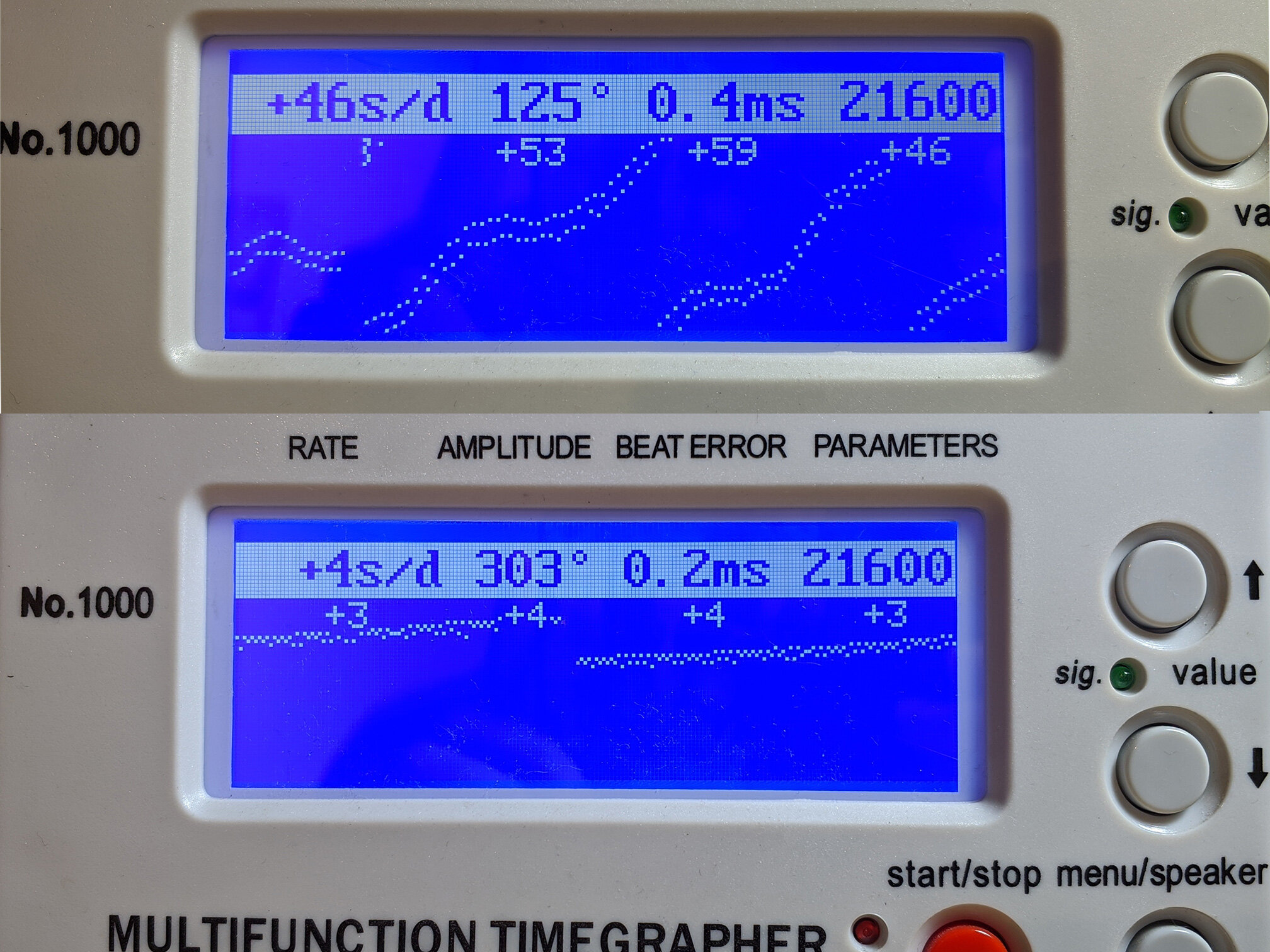
Amplitude reflects the balance wheel swing angle measured in degrees. It is a vital indicator of energy flow through the movement. At full wind, ideal amplitude ranges between 280 and 320 degrees. Below 250 degrees suggests insufficient power delivery, possibly due to dried lubricants, friction, or a weak mainspring. If amplitude drops below 200 degrees, do not attempt regulation. The movement needs servicing first.
Different movements have specific tolerances. The Sellita SW200 has a minimum of 210 degrees up to 315 degrees. The Seiko NH35 typically runs around 270 to 300 degrees. The Miyota 8 series ranges from 230 to 315 degrees. Ensure your timegrapher is set to the correct lift angle to calculate amplitude accurately. An incorrect setting skews readings and leads to misguided adjustments.
Diagnose Beat Error
Beat error measures the symmetry of the tick-tock cycle in milliseconds. Ideally, both ticks should be evenly spaced. A beat error under 0.6 milliseconds is acceptable. Above that, the watch may struggle to start on its own or suffer uneven wear.
High beat error often stems from misaligned hairspring or displaced stud carrier. As you adjust the regulator, this value can shift. Always check it before fine-tuning the rate. If beat error exceeds 2.0 milliseconds or the watch stops intermittently, seek professional help. Attempting regulation with significant imbalance risks damaging the escapement.
Prepare the Movement Safely
Before making any adjustments, access the movement with caution. Regulating a watch involves exposing sensitive components like the balance wheel and hairspring. Both are easily damaged by static, dust, or improper handling. Rushing this step can lead to costly repairs. Work slowly, use the correct tools, and follow best practices to protect your timepiece.
Open the Case Correctly
Use the appropriate caseback tool whether a case knife, spanner, or screwdriver depending on your watch design. Never force open a sealed case. To prevent debris from falling into the movement, place the watch face-down on a soft surface during removal. Avoid wearing wool or synthetic fabrics that generate static, which can attract dust or magnetize parts.
Once open, inspect the movement for visible issues. Look for dried oil, foreign particles, or bent components. If anything looks amiss, stop and consider professional servicing instead of proceeding with regulation.
Set Up Your Workspace
Create a clean, well-lit environment free from vibrations and airflow. Use a microfiber or vinyl pad to prevent scratches. Wear finger cots or gloves to avoid transferring oils to the movement. Keep a blower brush nearby to gently remove dust without direct contact.
Have these tools ready.
• Non-magnetic tweezers
• Magnifying loupe (10x to 20x)
• Wooden matchstick or plastic probe
• Lint-free swabs
Never touch the balance wheel or hairspring with metal tools. Even slight contact can bend the hairspring, requiring expert realignment.
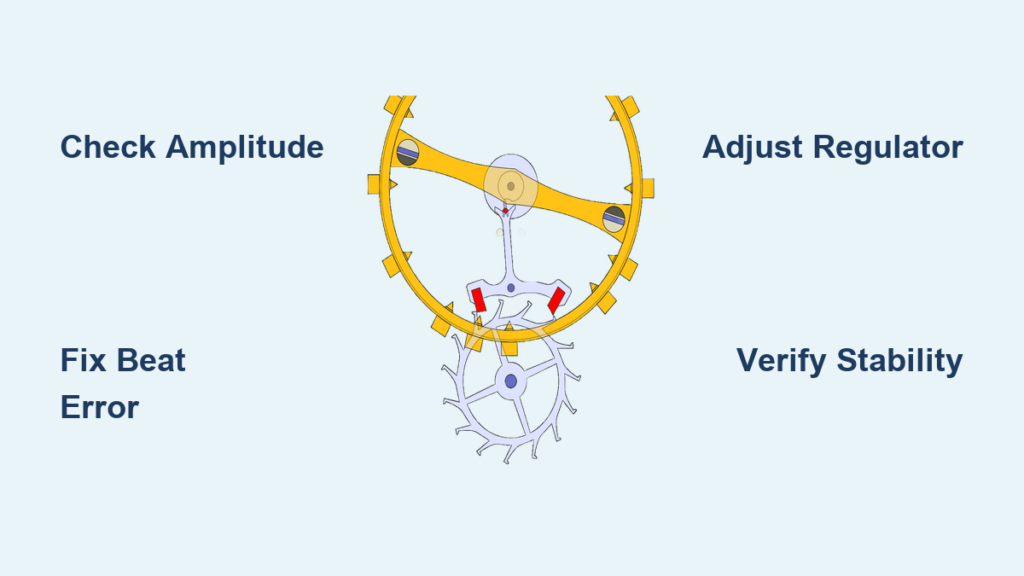
Fix Beat Error First
Always correct beat error before adjusting the rate. This is crucial because moving the stud carrier to center the hairspring affects timing. If you adjust speed first, fixing beat error afterward could undo your work. Addressing beat error ensures the escapement operates symmetrically, laying the foundation for accurate regulation.
Locate the Stud Carrier
The mobile stud carrier anchors the outer end of the hairspring. On many movements, it is adjustable via tiny grooves or screws. Using fine-tipped non-magnetic tweezers or a wooden stick, gently nudge the stud left or right. Each micro-movement changes the alignment of the hairspring and reduces beat error.
Watch the timegrapher in real time. Adjust in 0.1 millimeter increments. Small shifts make big differences. Re-measure after each change. Your goal is under 0.6 milliseconds.
Some vintage or budget movements have fixed stud carriers. In those cases, beat error correction is not user-accessible. Leave it to a watchmaker with specialized equipment.
Avoid Hairspring Contact
Never let tools touch the coiled portion of the hairspring. Its fragility means even a minor bend alters elasticity and timing unpredictably. If the spring appears distorted or tangled, cease all attempts and seek professional service. Attempting DIY repair here often leads to complete failure.
After achieving proper beat error, double-check amplitude. If it dropped significantly, something is impeding motion, possibly a displaced spring or obstruction.
Adjust the Regulator Lever
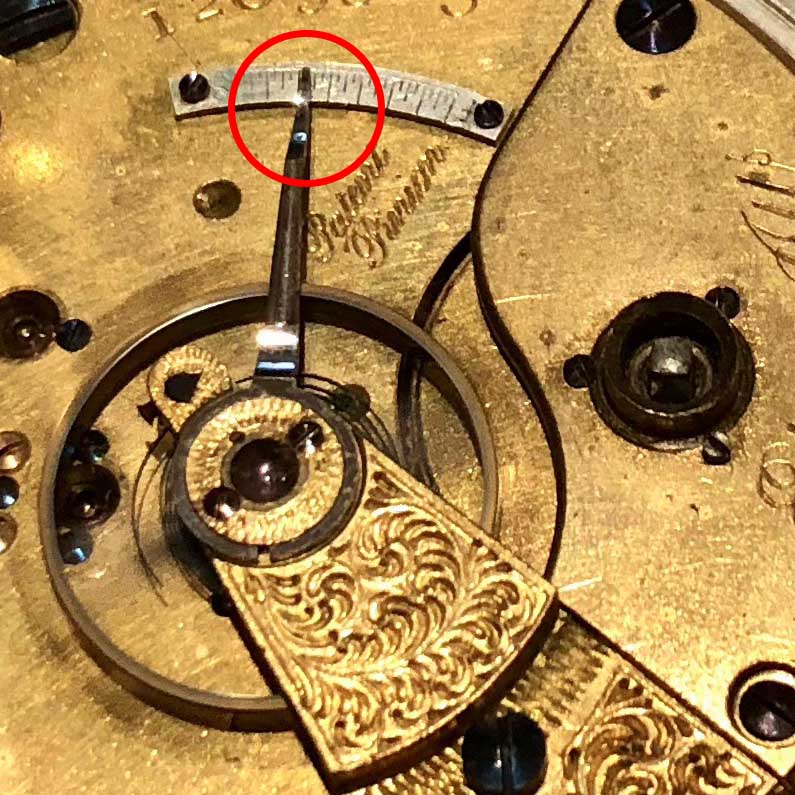
With beat error corrected, you are ready to regulate the rate. This is done using the regulator lever, which shifts index pins to change the effective length of the hairspring. Shorter length means faster time. Longer means slower. Most levers are marked with plus and minus indicators near the balance cock.
Move Toward Plus or Minus
To speed up the watch, correcting a slow rate, slide the lever toward the plus side. To slow it down, if gaining time, move toward minus. Use a plastic or wooden tool for control. Metal can slip and damage the hairspring.
Make micro-adjustments only. One small shift can alter the rate by several seconds per day. After each change, close the case and test on the timegrapher in the same position. Dial-up is recommended. Wait a few minutes for stable readings.
Aim for a slightly positive rate between plus two and plus five seconds per day. Mechanical watches tend to slow over time as the mainspring unwinds. Starting just fast compensates for this drift.
Use Swan-Neck or Micro Adjusters
Some high-end movements feature swan-neck regulators or micro-adjust screws instead of a sliding lever. These allow ultra-fine tuning. For swan-neck regulators, turn the screw clockwise to speed up and counterclockwise to slow down. Micro-adjust screws, found in Rolex and Omega, shift the regulator minutely via tiny screw turns.
These systems offer superior precision but require steady hands and magnification. Over-tightening can strip threads or deform components.
Verify Final Performance
After regulation, confirm stability and accuracy. A one-time reading is not enough. Your fix must hold under normal conditions. Reassemble the watch carefully and run final diagnostics.
Reinstall the Caseback Securely
Before closing, clean the inner caseback with a lint-free swab to remove dust or fibers. Align the case properly and press or screw it shut using the correct tool. Avoid over-tightening, which can warp the case or damage gaskets.
Once sealed, place the watch back on the timegrapher in dial-up position. Let it run for at least five minutes to gather consistent data.
Confirm Stable Metrics
Check all three key indicators. Rate should be within plus or minus ten seconds per day, or plus or minus five seconds per day for high precision. Amplitude should be above 250 degrees, ideally between 280 and 320 degrees. Beat error should still be under 0.6 milliseconds.
If any metric is off, reopen and recheck. Small disturbances during reassembly can shift the regulator or beat error. Monitor the watch over 24 to 48 hours while wearing it normally. Daily variations of a few seconds are normal due to position, temperature, and activity level.
Try Non-Invasive Positioning
If you do not own a timegrapher or prefer not to open the case, positional storage offers a gentle way to influence daily rate. While not true regulation, this method leverages gravity effect on the balance wheel to subtly alter timing.
Store Crown Up to Speed Up
If your watch runs slow, store it overnight on its side with the crown pointing upward. This position may slightly increase the rate by reducing friction in certain orientations.
Conversely, if it runs fast, store it with the crown pointing downward. This often slows the movement slightly.
Results vary widely. Some watches respond. Others do not or react oppositely. The effect is subtle, typically changing the rate by only a few seconds per day. It is not a fix for large deviations or erratic behavior.
This method works best on healthy, fully wound movements. Use it as a complement, not a substitute, for proper regulation.
Know When to Stop
Even with the best intentions, there are times when you should not regulate a watch yourself. Pushing forward without proper tools or understanding risks permanent damage. Recognizing the limits of DIY is part of responsible ownership.
Seek Professional Help If
Certain conditions require expert intervention. Amplitude below 200 degrees indicates the movement needs servicing, not adjustment. Beat error exceeding 2.0 milliseconds suggests serious mechanical problems. The watch stops randomly or ticks irregularly. You suspect magnetism, common in modern environments from phones and laptops. The movement shows signs of corrosion, dried oil, or impact damage.
Also, if your watch is under warranty, opening the case may void coverage. Contact the manufacturer or an authorized service center instead. Professionals have tools like demagnetizers, ultrasonic cleaners, and timing machines that go beyond what is possible at home. They can also perform full positional adjustments, something no DIY method can replicate.
Maintain Realistic Expectations
Mechanical watches are marvels of micro-engineering, but they are not atomic clocks. Accepting their natural variance is key to enjoying them long-term. A deviation of 20 seconds per day equates to less than 0.0231 percent change in frequency. This is an astonishing level of precision, yet still noticeable on the wrist.
Understand Factory Tolerances
Some manufacturers specify acceptable ranges as wide as plus 45 to minus 35 seconds per day for certain movements. If your watch stays within spec, regulation may be unnecessary unless personal preference demands tighter accuracy.
COSC-certified chronometers are held to higher standards, but even they vary slightly day to day. High-end precision does not mean perfect accuracy.
Choose Your Preferred Drift
Many owners prefer their watches to run slightly fast, between plus five and plus ten seconds per day. Why? Because it is easier to reset. Pull the crown out for a couple of minutes, then push it back in. The watch instantly catches up to the correct time.
In contrast, a slow watch requires waiting or manual setting every day. Consider your lifestyle when choosing a target rate.
If you need sub-second accuracy, consider quartz or GPS-synced watches. Mechanical timepieces are valued for craftsmanship, history, and emotion, not perfect precision.
Frequently Asked Questions About Watch Regulation
Can I Regulate a Watch Without a Timegrapher?
You can尝试 positional adjustments by storing the watch with the crown in different positions overnight. However, this method produces subtle results and does not address underlying issues. For accurate regulation, a timegrapher is essential. Without one, you are guessing rather than making precise adjustments.
How Often Should I Regulate My Watch?
There is no set schedule for regulation. Check your watch every six to twelve months using a timegrapher to monitor performance. Only adjust when the rate falls outside your acceptable range. Avoid over-regulating, as each adjustment carries risk to delicate components.
What Causes a Watch to Gain Time Suddenly?
Sudden fast gain often indicates magnetic exposure. Modern devices like smartphones, speakers, and laptop computers can magnetize a watch quickly. Before regulating, demagnetize the watch using a proper demagnetizing tool. This often resolves the issue without any adjustment needed.
Is Regulation Safe for Vintage Watches?
Vintage watches require extra caution. Many have fixed stud carriers that cannot be adjusted without professional tools. Older movements may have fragile components that are more susceptible to damage. If your vintage watch has value or sentimental importance, consider professional regulation to avoid costly mistakes.
What Is the Difference Between Regulation and Adjustment?
Regulation addresses consistent rate errors by adjusting the regulator lever. Adjustment involves calibrating for positional variance, temperature changes, and other environmental factors. Adjustment is typically performed during manufacturing or complete servicing and is not recommended for DIY attempts.
Can Regulation Fix a Watch That Stopped Working?
No. If your watch has stopped, regulation will not help. The issue likely involves power delivery, damaged components, or severe beat error preventing self-starting. Check amplitude first. If it is below 200 degrees, the movement needs servicing, not regulation.
Key Takeaways for Regulating Your Watch
Regulation enhances performance but does not replace servicing. A well-regulated watch still requires cleaning, lubrication, and inspection every five to seven years to maintain longevity and accuracy. The process begins with diagnosis using a timegrapher to measure rate, amplitude, and beat error. Always correct beat error before adjusting the regulator lever. Make micro-adjustments only and verify stability over 24 to 48 hours before finalizing.
Remember that mechanical watches are designed to run within tolerances, not perfectly. Accept their natural variance and enjoy the craftsmanship. If the watch shows signs of damage, low amplitude, or erratic behavior, seek professional help rather than forcing adjustments. With proper care and realistic expectations, your mechanical timepiece will serve reliably for generations.