You just bought a new watch, slipped it on, and it slides around your wrist like it is trying to escape. You do not have a watch tool, and you are not about to pay $20 for a five-minute job. Good news: you can resize a watch without tools using everyday household items. Whether it is a steel bracelet, a folded link band, or a sleek Milanese mesh, this guide walks you through safe, proven methods to achieve a perfect fit without professional equipment.
Most metal watch bands, especially pin-connected steel bracelets, are designed to be adjustable. The trick is knowing your band type, using the right household substitute, and working with precision. Many people remove links unnecessarily when a micro-adjust clasp would have done the job. This guide prevents those mistakes. You will learn how to identify your bracelet, push out pins safely, remove links, and reconnect everything securely using a thumbtack, a screwdriver, and a coin.
Identify Your Watch Bracelet Type First

Before touching any tool, determine what kind of band you are dealing with. The method depends entirely on construction, and using the wrong technique can damage your watch.
Pin-Connected Steel Bracelets
Most common on Seiko, Citizen, Tissot, and Hamilton watches. Links are held by metal pins with stamped arrows on the inside showing the ejection direction. Push the pin in the arrow is pointing direction. Never push against the arrow or you risk collapsing the link. These are the easiest to adjust without tools.
Screw-Connected Luxury Bands
Found on Omega, Rolex, and TAG Heuer. Links are secured with tiny screws, sometimes glued in place. Do not attempt removal with household tools. You will strip the screws or damage the finish. Take these to a professional jeweler instead.
Folded Link Blind Pin Bands
Common on cheap or vintage watches from brands like Shein or AliExpress. Pins are fully enclosed with no visible ends. No arrows are stamped on these bands. The metal is very thin and bends easily. Use penetrating oil and work slowly if you must attempt this.
Milanese Mesh Bracelets
Woven stainless steel with a magnetic or mechanical slider. No tools are needed. Simply slide the clasp to adjust. The range is limited, so this only works for small changes.
Micro-Adjust and Stretch Bands
Found on dive watches from Rolex, Omega, and Seiko. These allow fine-tuning without removing links. Some let you remove outer segments for permanent shortening. The internal pins are spring-loaded, so handle them carefully.
Gather These Household Substitutes
You do not need a $30 watch tool kit. These common items work just as well for most band types.
A thumbtack pushes pins out manually and fits most pin holes. A SIM card ejector tool has a rigid metal tip perfect for starting stubborn pins. A flat-head screwdriver applies tapping force or leverage. A hammer or screwdriver handle delivers controlled taps. A pencil, toothpick, or nail acts as a fine punch. A quarter seats pins flush after reinsertion. Two books create a stable cradle to support the band. Penetrating oil like WD-40 or Kroil loosens old, stuck pins. Tweezers or needle-nose pliers pull out partially ejected pins. A soft cloth or rubber mat prevents scratches. A small tray keeps tiny pins and links from rolling away.
How to Remove Links Without Tools
Check the Arrows First
Flip the watch over and look for tiny stamped arrows on the inner side of the links. These show the only safe direction to push the pin. Arrow points left means push pin from right to left. No arrows present means look at the pin ends: one side is rounded and the other is flat or rough. Push from the rounded side toward the flat side.
Set Up a Stable Work Area
Use two stacks of books to create a cradle. Place the watch so the target link hangs slightly over the gap between the books. This lets the pin move freely without hitting the table. Place a soft cloth or foam pad underneath to prevent dents. Work on a non-slip surface like a rubber mat. Use good lighting so you can see tiny arrows and holes. Remove equal links from both sides if possible to keep the clasp centered.
Push Out the Pin
For loose or budget pins, insert the sharp end of a thumbtack into the pin hole and push in the direction of the arrow using finger pressure alone. For pins that need more force, hold the thumbtack against the pin and tap the end gently with a screwdriver handle or hammer. Use short, controlled taps and stop once the pin sticks out 3 to 5 millimeters. For stubborn pins, use a sharpened pencil, toothpick, or nail as a punch. Align it with the pin hole and tap gently in bursts, checking progress after each tap. Never use excessive force or you risk bending the pin or link.
Extract the Pin
Once the pin is partially out, use tweezers, needle-nose pliers, or your fingertips to grab it. Pull straight out to avoid bending. Place the pin and link in a small container because you may need them later.
Remove the Link
Detach the unwanted link from the band. If shortening both sides, count carefully and remove the same number from each side. Double-check the fit before reassembling by holding the band up to your wrist.
Reinsert the Pin
Align the two ends of the band and insert the wider end of the pin first to ensure correct orientation. Push it in the same direction as removal, following the arrow. Stop when you feel resistance.
Seat the Pin Flush
Use a quarter or coin to press the pin fully in until it is flush with the link surface. For a recessed finish, use the corner of a screwdriver held steady with your thumb to press the pin just below the surface. The final result should be smooth with no sharp edges. If the pin feels loose, apply a tiny drop of clear nail polish to the tip before reinsertion. It dries clear and holds the pin without permanent bonding.
Adjust Without Removing Links
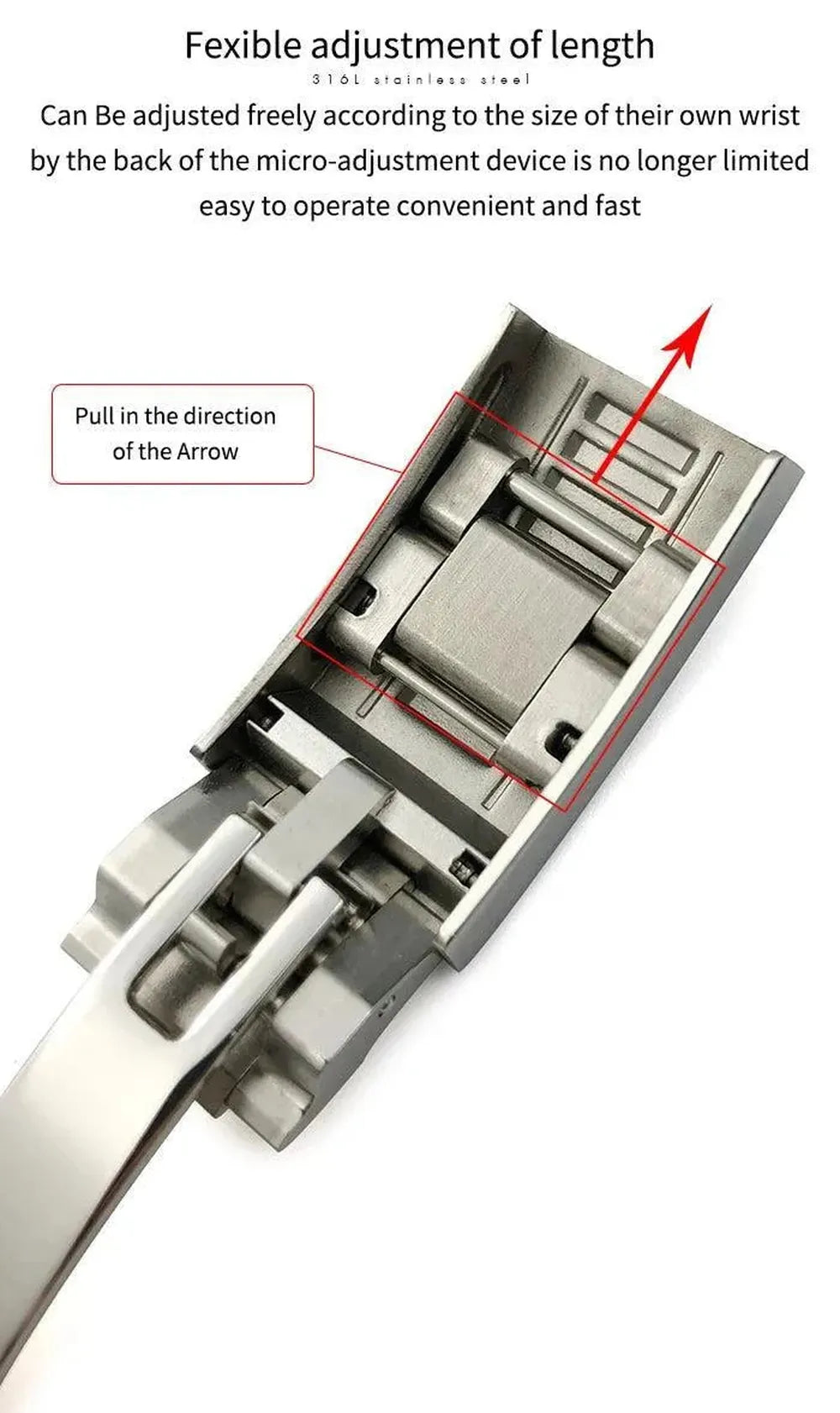
Use Micro-Adjust Clasps
Many bracelets let you fine-tune the fit without removing links at all. Open the clasp and look for small notches or side pin holes. Insert a thumbtack into the hole and push the pin inward while sliding the band to the next notch. It will snap into place. This method is ideal for temporary changes like wrist swelling or seasonal fit adjustments.
Stretch Bands and Deployant Clasps
Found on Rolex Glidelock, Omega Seamaster, and Seiko divers. Open the clasp and slide the micro-adjust mechanism outward. Remove the outer folded segment and reconnect by aligning the core and tapping the pin back in. Work slowly because spring-loaded pins can jump out unexpectedly.
Special Case: Folded Link Bracelets
These are tricky because the metal is thin, pins are not visible, and the band may be fused shut from years of accumulated sweat and skin oils.
Apply Penetrating Oil First
Use Kroil or WD-40 and put a tiny drop where the pin enters the link. Wait 15 to 30 minutes. This breaks down corrosion and makes the pins easier to move.
Use a Fine Punch
Use a sharpened pencil tip or toothpick as a punch. Tap gently with a screwdriver handle. Work in a few taps at a time and check progress after each one.
Reassemble Carefully
Reinsert the pin in the same direction as removal. If it feels loose, use clear nail polish on the tip for temporary hold. Consider replacing the band entirely if it is in poor condition because aftermarket mesh bands cost only $10 to $15.
Milanese Strap Adjustment
Milanese straps adjust in seconds without any tools. Open the magnetic or mechanical slider. Slide it along the band to shorten or lengthen the fit. Ensure both ends are fully hidden under the slider before locking the cap. The limitation is that you cannot shorten beyond the slider is range. If the ends protrude, the band needs professional cutting.
Common Mistakes to Avoid
Pushing pins in the wrong direction can destroy the link entirely. Using dull tools causes scratches or deforms the metal. Hammering too hard bends pins or links. Ignoring arrows leads to irreversible damage. Skipping stabilization causes slippage and potential injury. Working slowly prevents 90 percent of DIY watch disasters.
When to Skip DIY and Go Professional
Certain situations call for a jeweler instead of household tools. Screw-connected bands require professional removal. Glued or heat-locked screws should not be attempted at home. High-value or vintage watches should always go to a pro. First-time users should practice on a cheap watch first. Folded link bands in poor condition may need replacement rather than repair.
Most jewelers charge $5 to $20, often free with purchase. Walmart and Target jewelry counters frequently resize watches for free. For a budget watch, this may be the smartest route.
Real-World Tips from Watch Users
Take it to Walmart. The jewelry department will do it free. Just spend $10 on a replacement bracelet from eBay instead of fighting with a fragile folded band. Use a magnet to catch falling pins because steel pins are magnetic. Tap with the screwdriver handle, not the blade, to reduce scratching. Start with an old or inexpensive watch to build confidence before touching your favorite timepiece. Count twice and remove once to avoid removing the wrong number of links.
Final Checklist for Resizing a Watch Without Tools
Identify your bracelet type. Check for arrows and follow the direction. Gather household tools including thumbtack, screwdriver, coin, and tweezers. Apply penetrating oil if the band is old. Use two books to support the link during work. Push the pin with thumbtack and gentle tapping. Remove the link and save the pin. Reinsert the pin wide end first in the same direction. Seat it flush with a coin or screwdriver corner. Test the fit and adjust the micro-clasp if needed.
Frequently Asked Questions About Resizing a Watch Without Tools
Can I resize any watch band without tools?
No. Pin-connected steel bracelets are the easiest to resize without tools. Screw-connected luxury bands, glued systems, and some folded link bands require professional tools or should be left to a jeweler.
What household items can I use to push out watch pins?
A thumbtack, SIM card ejector tool, flat-head screwdriver, pencil, or even a nail can work as a punch. Use a coin to seat pins flush and tweezers to extract them.
How do I know which direction to push the pin?
Look for stamped arrows on the inner side of the link. Push in the direction the arrow points. If no arrows exist, push from the rounded end toward the flat end.
What if the pin is stuck and will not move?
Apply penetrating oil like WD-40 or Kroil and wait 15 to 30 minutes. The oil breaks down corrosion and makes the pin easier to move. Tap gently with a screwdriver handle rather than forcing it.
Can I adjust a Milanese mesh strap without tools?
Yes. Simply open the slider and slide it along the band to adjust the length. This method requires no tools but has limited range.
Key Takeaways for Resizing Your Watch Without Tools
Resizing a watch without tools is entirely possible for most pin-connected steel bracelets. With patience and the right household items like a thumbtack, screwdriver, and coin, you can achieve a custom fit in under 15 minutes. Always identify your bracelet type first because screw-connected and luxury bands require professional tools. Start with the least forceful method and work up to tapping only when finger pressure does not work. Grab a thumbtack, set up your work area, and get started.