Choosing the right watch strap isn’t just about style. It’s about fit, comfort, and function. If your strap is too short, it’s uncomfortable and hard to fasten. Too long, and the tail dangles awkwardly. The key is knowing your watch strap length. This guide breaks down exactly how to measure, choose, and match the perfect strap length to your wrist and watch case.
You’ll learn how to measure your wrist accurately, decode strap size labels like 125/75 mm, and avoid common sizing mistakes. Whether you’re replacing a leather strap, upgrading to a NATO, or switching to a deployant clasp, this guide gives you the precise data to make the best choice.
Measure Your Wrist for Accurate Sizing
Before buying any watch strap, you need to know your wrist size. A proper fit starts with accurate measurement. This step takes less than two minutes but saves you from ordering the wrong size.
Using a Soft Tape Measure or String
Wrap a flexible tape measure around your wrist just below the wrist bone where you normally wear your watch. Keep it snug but not tight. If you don’t have a tape measure, use a non-stretch string, mark where it meets, then measure against a ruler. Record your measurement in millimeters for precision.
Pro Tip: Measure in the evening. Wrist size can swell slightly during the day due to activity and hydration levels.
Accounting for Your Fit Preference
Do you like a tighter or looser fit? Allow 1 to 2 millimeters of extra space for comfort if you prefer a looser feel. If you prefer a snug feel common with sports watches, subtract 1 to 2 millimeters from your actual measurement when selecting strap length.
Visual Cue: You should be able to slide a finger under the strap with slight resistance.
Decoding Strap Length Labels Like 125/75 mm

Most two-piece watch straps list their size using a dual-number format. This isn’t total length. It represents two separate measurements that tell you exactly how each end of the strap is sized.
Understanding the X/Y Format
The format X/Y mm breaks down as follows. X represents the long end also called the tail side, measured from the spring bar hole to the strap end. Y represents the short end also called the buckle side, measured from the spring bar hole to the tip. The buckle itself is not included in either number.
Example: A 125/75 mm strap has a 125 mm tail and 75 mm buckle side. Total length equals 200 mm.
Calculating Usable Strap Length
Total length equals X plus Y. However, usable length equals approximately X plus Y minus 40 mm due to hole spacing and overlap where the strap wraps around your wrist. A 125/75 mm strap with 200 mm total offers roughly 160 mm of functional length.
Why the Split Matters
The longer tail X provides more adjustment range and works better for larger wrists. The shorter buckle side Y creates a cleaner look with the buckle sitting closer to the watch case. Choose based on your wrist size and aesthetic preference.
Matching Wrist Size to Strap Length
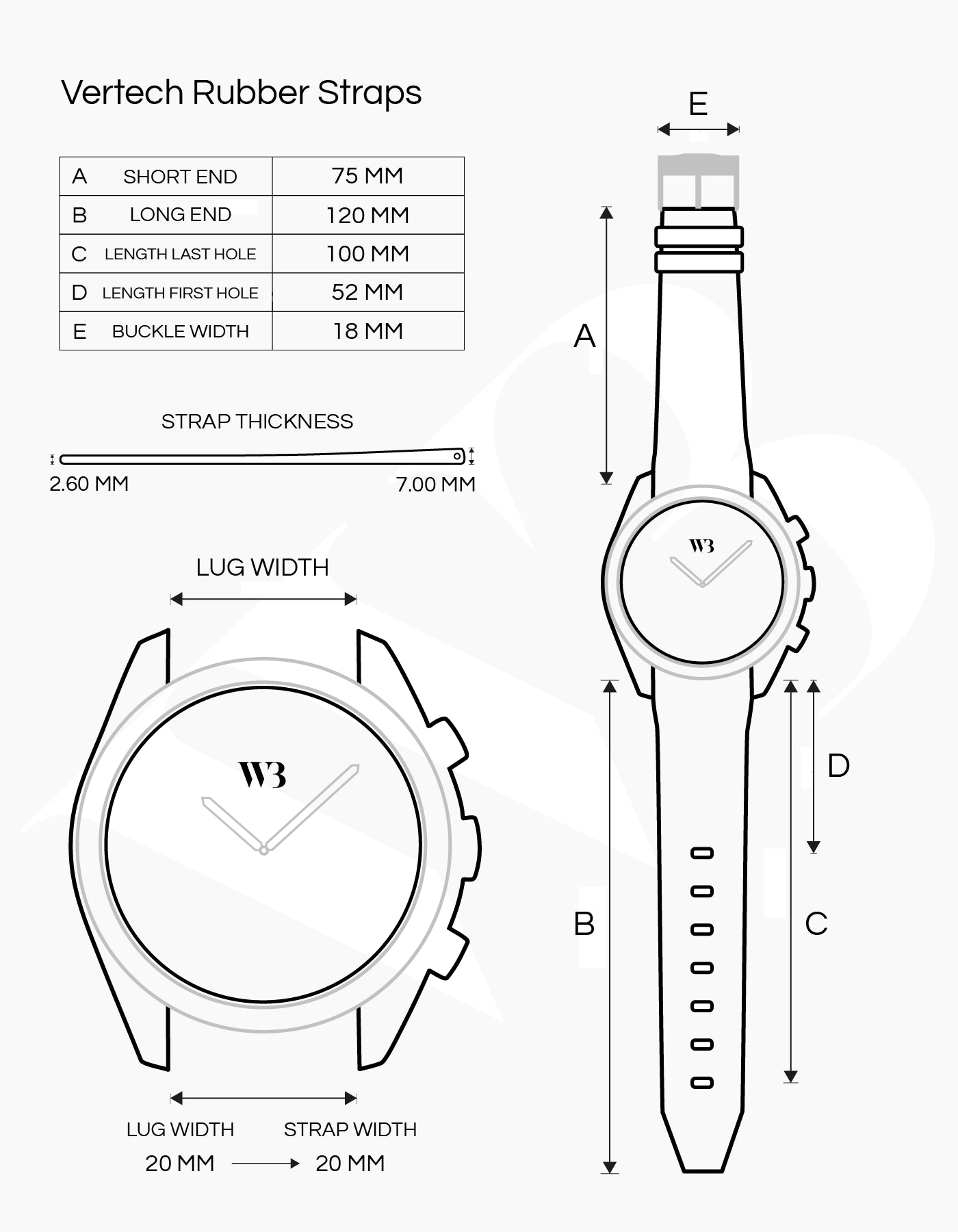
Use this universal chart to find your ideal watch strap length based on your actual wrist measurement. These recommendations work for most two-piece straps including leather, rubber, and synthetic materials.
Standard Strap Lengths by Wrist Size
| Wrist Circumference | Recommended Strap Length | Size Category |
|---|---|---|
| 146–165 mm (5.75″–6.5″) | 105/70, 110/70 | Short |
| 165–178 mm (6.6″–7.0″) | 125/75 | Regular |
| 179–190 mm (7.1″–7.5″) | 130/80 | Regular/Long |
| 191–203 mm (7.6″–8.0″) | 135/85 | Long |
| 204–216 mm (8.1″–8.5″) | 140/85 | Long |
| 217–229 mm (8.6″–9.0″) | 145/90 | Extra Long |
Note: Brands vary significantly. What one company calls Regular might mean 115/75 mm while another uses 120/75 mm. Always check exact millimeter specifications on product pages.
What If You’re Between Sizes
Size up if you prefer a looser fit or wear your watch over clothing sleeves. Size down for a cleaner dressier look with minimal tail showing. When in doubt, measure your current strap to use as a reference for the next section.
Measuring Your Current Strap for Replacement

If your existing watch strap fits well, use it as a reference template. This is often the most reliable method because you’re working with something you already know works.
Removing and Laying the Strap Flat
Take the strap off your watch carefully using a spring bar tool if needed. Lay it completely flat on a table without stretching the material. Any stretching during measurement will give you inaccurate numbers.
Measuring Each End Separately
Measure the tail side from the spring bar hole to the end of the strap. Measure the buckle side from the spring bar hole to the tip of the strap. Do not include the buckle itself in either measurement.
Example: You measure 123 mm on the tail side and 74 mm on the buckle side. Look for a 125/75 mm replacement strap.
Accounting for Material Differences
Thinner straps like Horween leather may feel longer due to less bulk. A 115/75 mm strap might fit like a 120/75 mm because the material compresses differently. Adjust your expectations when switching between materials.
Using Wrist Size Plus Watch Dimensions
For the most accurate fit, factor in your watch’s lug-to-lug distance. This method accounts for both your wrist size and the physical dimensions of your watch case.
Applying the Formula
The calculation works as follows. Subtract your watch’s lug-to-lug distance from your wrist circumference. The result represents the required length between spring bars for proper fit.
Example: Your wrist measures 175 mm and your watch has a 41 mm lug-to-lug distance. Calculation gives you 134 mm. A strap with 134/154 mm total length would offer sufficient adjustment with usable length around 268 mm.
Factors That Influence This Calculation
Thicker straps require slightly longer lengths for comfortable wrapping around your wrist. Leather and rubber may stretch over time while nylon can shrink when wet. If you prefer a tighter fit, you may need a longer strap to avoid using only the last holes.
Special Considerations for Different Strap Types
Certain strap styles require different sizing approaches. Understanding these differences prevents common fit problems.
Deployant Clasps Require Shorter Straps
Deployant clasps replace part of the strap’s functional length. They typically add 30 to 50 mm of extension when open. As a result, a shorter physical strap is often required compared to a standard pin buckle.
Recommendation: When switching from a pin buckle to a deployant clasp, choose a strap that is 5 to 10 mm shorter in total length.
NATO Strap Sizing Differs
Standard NATO straps with 13 holes measure 11 inches or 280 mm and fit wrists from approximately 5.75 to 9.0 inches. Supreme NATO straps measure 11.5 inches or 290 mm and fit wrists from approximately 6.0 to 9.25 inches. NATO straps thread through both spring bars which doubles the effective length and allows wide adjustability.
Perlon and Chevron Straps Offer Adjustability
Perlon straps use an adjustable weave design with infinite sizing. Maximum length reaches 9.5 inches or 240 mm fitting wrists from approximately 5.0 to 8.0 inches. Chevron straps use an adjustable sliding buckle system with maximum length of 10 inches or 255 mm fitting wrists from approximately 6.0 to 8.0 inches.
Troubleshooting Common Fit Problems
Several issues commonly occur when watch strap length is incorrect. Knowing the cause helps you find the right solution quickly.
Strap Feels Too Tight or Too Loose
If your strap feels too tight, your length is likely too short or you chose the wrong size category. Size up or choose a longer tail length. If your strap feels too loose, your length is too long. Size down and avoid excessive tail that extends past the second keeper.
Buckle Sits Too Far From the Watch Case
This happens when you choose a strap with a longer buckle side Y than your watch requires. Select a shorter buckle side for a cleaner look with the buckle sitting closer to the case.
Tail Doesn’t Reach the First Keeper
Your strap is too short if the tail barely reaches the first keeper. This creates discomfort and limits adjustment options. Increase your tail length X to ensure the strap reaches through the first keeper and rests near the second keeper.
Deployant Clasp Feels Short After Switching
This occurs when using a standard strap length with a deployant clasp. The clasp mechanism consumes some functional length. Use a strap 5 to 10 mm shorter than you would for a pin buckle equivalent.
Frequently Asked Questions About Watch Strap Length
How do I measure my wrist for a watch strap?
Wrap a flexible tape measure around your wrist just below the wrist bone where you normally wear your watch. Keep it snug but allow for 1 to 2 mm of extra space for comfort. Measure in millimeters for the most precise results.
What does 125/75 mm mean on a watch strap?
The first number represents the length of the long end or tail side measured from the spring bar hole to the strap end. The second number represents the length of the short end or buckle side measured from the spring bar hole to the tip. The buckle itself is not included in either measurement.
What strap length do I need for a 7-inch wrist?
A wrist circumference of 7 inches or approximately 178 mm typically works well with a 125/75 mm or 130/80 mm strap depending on your watch case size and personal preference for fit tightness.
Can I use a NATO strap if my wrist is very small?
Yes. Standard NATO straps fit wrists from approximately 5.75 inches to 9.0 inches due to their adjustable design. For extremely small wrists under 5.75 inches, look for Short size two-piece straps or consider a Perlon strap with its infinite adjustment system.
How do I know if my watch strap tail is the right length?
The ideal tail length passes through the first keeper and rests near or just enters the second keeper. If the tail extends far beyond the second keeper, your strap is too long. If the tail barely reaches the first keeper, your strap is too short.
Should I size up or down if I’m between watch strap sizes?
Size up if you prefer a looser fit or wear your watch over clothing sleeves. Size down for a cleaner dressier look with minimal tail showing. Consider your material choice since leather stretches over time while rubber maintains consistent length.
Key Takeaways for Finding Your Perfect Watch Strap Length
Finding the right watch strap length comes down to three essential steps. First, measure your wrist accurately using a soft tape or string at the location where you wear your watch. Second, understand the dual-number format by knowing that X/Y mm represents tail length and buckle side length separately. Third, use the sizing chart to match your wrist measurement to recommended strap lengths while accounting for your personal fit preference.
Remember that brands define size categories differently. Always verify exact millimeter specifications on product pages rather than relying solely on Short Regular Long labels. Consider your strap material since leather stretches while rubber stays consistent. For deployant clasps, choose a strap 5 to 10 mm shorter than you would for a pin buckle.
With your wrist measurement and these guidelines, you can confidently select a watch strap that fits comfortably and looks proportionate on your wrist every time you fasten your watch.