Imagine boarding a flight in New York at 8 AM, connecting through London, and landing in Tokyo the next day. Without checking your phone, how would you know what time it is back home? A GMT watch answers this exact problem by displaying two or more time zones simultaneously on a single dial. The term GMT stands for Greenwich Mean Time, the global time reference established in 1884 at the prime meridian in London. Today, GMT serves as the foundation for tracking multiple time zones, making this complication essential for pilots, frequent travelers, and anyone coordinating across continents.
This guide breaks down exactly how a GMT watch works, from its key components to step-by-step setup instructions. You will learn to read multiple time zones at a glance, understand the difference between movement types, and discover why this centuries-old complication remains relevant in the smartphone era.
What Defines a GMT Watch
A GMT watch differs fundamentally from a standard timepiece by adding the ability to track at least one additional time zone. The defining feature is a fourth hand that completes one rotation every 24 hours, paired with a 24-hour scale. This design eliminates AM/PM confusion entirely, since the scale runs from 0 to 24 rather than repeating twice daily.
The original GMT wristwatch was developed by Rolex in collaboration with Pan American Airways and launched in 1954 as the GMT-Master Ref. 6542. This model was designed specifically for long-haul pilots who needed to track Greenwich Mean Time alongside their departure or destination time. While Glycine released the Airman in 1953 with a 24-hour dial, it was the Rolex GMT-Master that popularized the functionality that defines the category today.
Key characteristics that make a GMT watch distinct include the independent 24-hour hand, the 24-hour scale for reading the second zone, and often a rotating bezel for tracking a third zone. These elements work together to provide instant multi-zone readability without any mental calculation.
The 24-Hour GMT Hand Explained
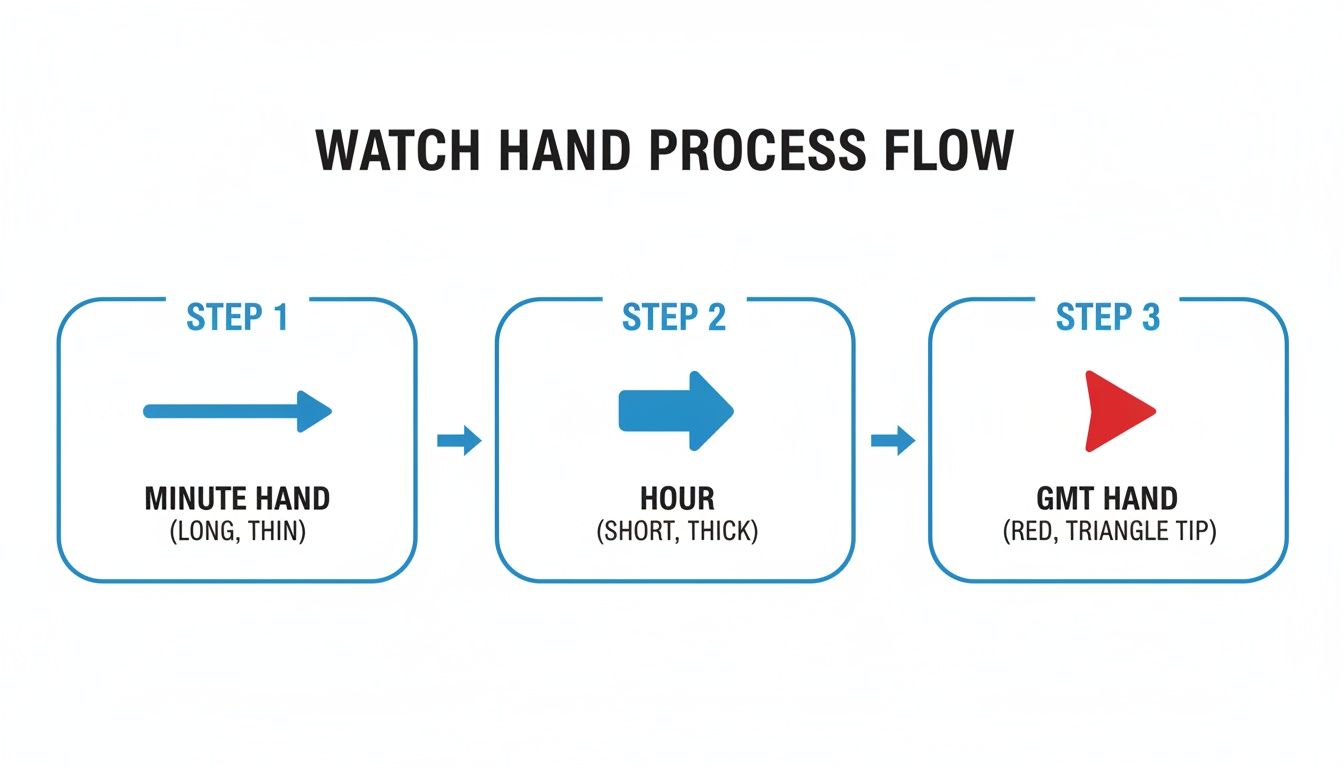
The GMT hand serves as the heart of any GMT watch. This fourth hand moves at half the speed of the regular hour hand, completing one full rotation every 24 hours rather than every 12 hours. This slower movement allows it to clearly indicate whether it is morning or afternoon in the second time zone.
Most GMT hands feature a distinctive color to stand out from the main time display. Common colors include red, blue, orange, and black with a luminous tip. This visual distinction makes it easy to differentiate the second time zone from local time at a glance.
On modern GMT watches, the GMT hand can typically be set independently of the main hour hand. This means you can adjust your local time for travel without disturbing your reference time zone. However, the GMT hand only displays hours. The minute and second hands are shared across all time zones tracked by the watch.
The 24-Hour Scale and Bezel Options
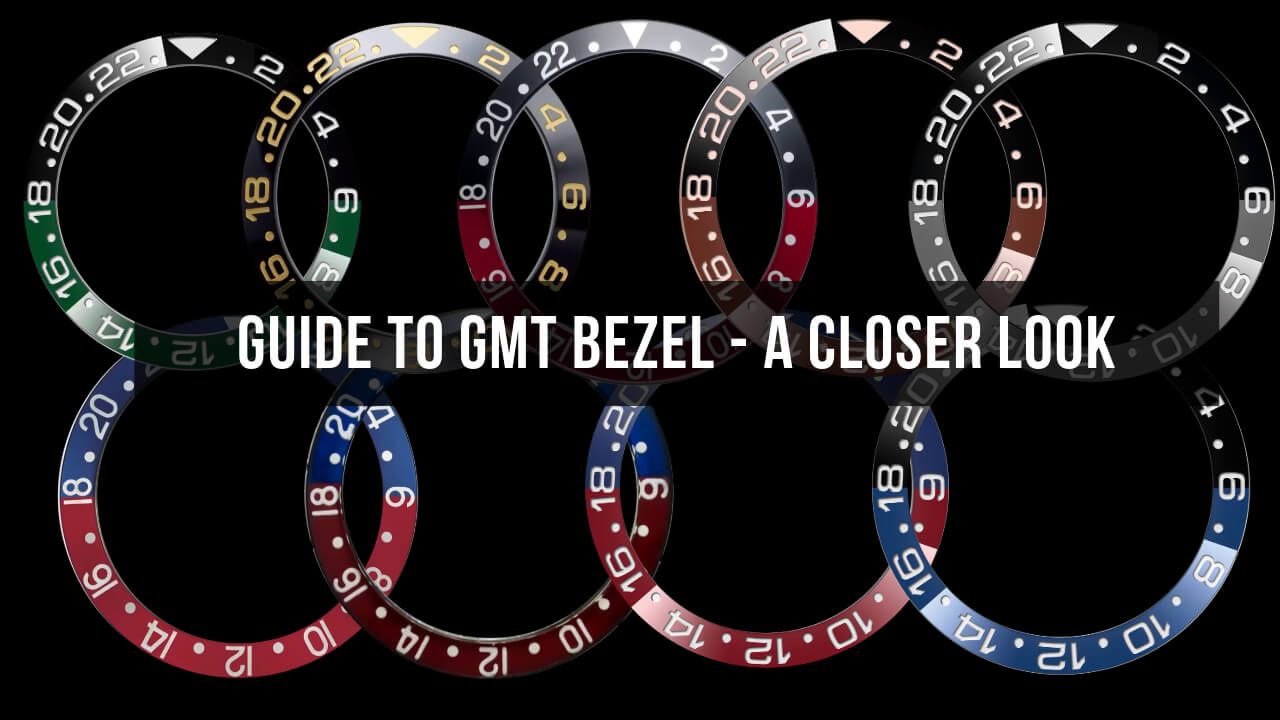
The 24-hour scale pairs with the GMT hand to enable reading of the second time zone. This scale may appear on the inner edge of the dial, around the dial periphery, on a rotating 24-hour bezel, or on an internal chapter ring. The scale runs from 0 to 24 or 1 to 24, eliminating any ambiguity about whether it is morning or evening.
Many GMT watches feature dual-color scales to indicate day and night visually. The iconic Rolex “Pepsi” bezel uses red to represent daytime hours and blue for nighttime. The “Batman” bezel pairs blue with black, while “Root Beer” uses brown and black. These color-coded bezels help users instantly determine whether it is appropriate to call someone in another time zone.
The rotating 24-hour bezel found on pilot and diver-style GMT watches enables tracking of a third time zone without touching the crown. By rotating the bezel to align a specific UTC offset with the 12 o’clock marker, you can read a third zone using the fixed GMT hand. This method is particularly valuable for travelers who frequently cross time zones.
Setting Your GMT Watch Step by Step
Setting a GMT watch involves adjusting the hands in a specific sequence to establish both local time and a reference time zone. Follow these steps for proper initial setup.
First, unscrew the crown and pull it to the fully-out position. This allows adjustment of the GMT hand along with the hour, minute, and second hands. Rotate the crown to set the GMT hand to your reference time zone, such as home time or UTC.
Next, push the crown to the halfway position. In this configuration, only the hour hand moves while minutes and seconds continue running uninterrupted. Rotate the crown to set your local time. The date wheel advances automatically as you pass midnight.
Finally, push the crown back to the fully-inserted position and screw it down to maintain water resistance. When traveling to a new time zone, simply pull the crown to the halfway position and rotate to jump the local hour hand forward or backward in one-hour increments. The GMT hand stays fixed, preserving your reference time.
Reading Multiple Time Zones at a Glance
Reading a GMT watch becomes intuitive once you understand the relationship between the hands and scales. Your local time displays through the main hour and minute hands exactly as you would read any standard watch.
To read your second time zone, look at where the GMT hand points on the 24-hour scale. If the GMT hand points to 15, it reads 3:00 PM in that zone. No calculation is required. The 24-hour format naturally communicates whether it is daytime or nighttime.
For tracking a third time zone using the rotating bezel method, set your GMT hand to UTC 0 as a reference point. Rotate the bezel so the desired UTC offset aligns with 12 o’clock. The GMT hand now indicates the correct time in that third zone. For example, if the GMT hand shows 15 and you rotate the bezel to place “+1” at 12 o’clock, it reads 4:00 PM in that zone.
Caller GMT vs Flyer GMT Movements

GMT movements fall into two main categories that determine how the hands adjust. Understanding this distinction helps you choose the right watch for your lifestyle.
Caller GMT movements, sometimes called Office GMT, allow independent adjustment of the GMT hand while the main hour hand stays fixed. This configuration works well for users who need to check time in other zones without changing their local time. These movements are more common in entry-level GMT watches like the Seiko 5 Sports GMT and Bulova Wilton GMT.
Flyer GMT movements, also called Traveler GMT, enable the local hour hand to jump independently while the GMT hand remains fixed. This design suits frequent travelers who change time zones often but want to maintain accurate home time. The Rolex GMT-Master II, Tudor Black Bay GMT, and Longines Spirit Zulu Time feature this true traveler functionality.
Advanced GMT Mechanisms Worth Knowing
Beyond standard GMT functionality, watchmakers have developed innovative interpretations that offer unique advantages.
The Parmigiani Fleurier Tonda PF GMT Rattrapante features a jumping local hour hand operated by a pusher at 8 o’clock. When traveling, press the pusher to advance the local hour hand. Upon returning home, a crown-integrated pusher snaps the local hand back to align with the home time hand. This mechanism draws inspiration from split-seconds chronographs.
The Jaeger-LeCoultre Reverso Duoface presents two separate dials. The front displays local time while the back shows a second time zone with a 24-hour display and day/night indicator. The swiveling case design eliminates hand overlap and provides independent timekeeping without mechanical complexity.
The A. Lange and Söhne Lange 1 Time Zone uses an asymmetrical dial layout with off-center main time and a subdial for the second zone. A rotating city ring lets you select different reference cities, and pressing a button swaps the displayed time zones.
Common GMT Watch Misconceptions
Several misunderstandings persist about GMT watches that deserve clarification.
The notion that GMT means two dials is incorrect. A GMT watch has one dial with a fourth hand and a 24-hour scale, not dual displays. Some models do feature additional dials, but these are separate complications rather than the defining GMT function.
The belief that all GMT watches have rotating bezels is also false. Some models like the Rolex Explorer II include fixed 24-hour scales. These are technically dual-time watches, not true rotating-bezel GMTs.
Another misconception involves the GMT hand showing minutes. The GMT hand indicates only hours. Minutes remain shared via the main minute hand across all tracked time zones.
Finally, assuming all countries use full-hour UTC offsets leads to inaccuracies. India uses UTC +5:30, and Nepal uses UTC +5:45. GMT watches assume hourly increments, so exact times in these zones require mental calculation.
Why GMT Watches Remain Relevant Today
Despite ubiquitous smartphones capable of displaying multiple time zones, GMT watches continue serving a vital function for many users. The instant analog readability requires no unlocking or navigating menus. A single glance provides complete time information without digital interaction.
These watches remain essential tools for pilots, military personnel, and international business professionals. The tactile engagement of mechanical watchmaking offers satisfaction that digital devices cannot replicate. A quality GMT watch can last decades with proper maintenance, representing long-term value compared to electronic devices with limited lifespans.
The horological artistry and craftsmanship behind GMT complications also appeal to watch enthusiasts. From the iconic Pepsi bezel to sophisticated mechanisms like the Parmigiani rattrapante, these timepieces represent centuries of innovation and design excellence.
Frequently Asked Questions About GMT Watches
What does GMT stand for in watches?
GMT stands for Greenwich Mean Time, the time at the prime meridian passing through Greenwich, London. Established in 1884, it serves as the global reference point for timekeeping and the foundation for the world’s 24 time zones.
Can a GMT watch show more than two time zones?
Yes. While the GMT hand tracks one second time zone, a rotating 24-hour bezel enables tracking a third zone. By setting the GMT hand to UTC and rotating the bezel to align different UTC offsets with 12 o’clock, you can read three time zones simultaneously.
Do I need to adjust my GMT watch when traveling?
With a Flyer GMT movement, you only need to pull the crown to the halfway position and rotate to jump the local hour hand in one-hour increments. The GMT hand stays fixed, preserving your reference time. Caller GMT models require adjusting the GMT hand instead.
Are GMT watches only for pilots?
While originally designed for aviators, GMT watches serve anyone who needs to track multiple time zones. Business travelers, remote workers coordinating with international teams, and families with members abroad all benefit from GMT functionality.
What is the difference between GMT and Worldtimer watches?
A GMT watch typically tracks 2-3 time zones using a 24-hour hand and optional rotating bezel. A Worldtimer watch displays all 24 time zones simultaneously through a rotating disc and city ring. Worldtimers offer a complete global overview but are more complex to read at a glance.
Key Takeaways for Understanding GMT Watches
A GMT watch works by adding a fourth hand that completes one rotation every 24 hours, paired with a 24-hour scale for reading a second time zone. The rotating bezel option enables tracking a third zone without adjusting any hands. Understanding the distinction between Caller GMT and Flyer GMT movements helps you choose a watch that matches your travel patterns.
The bezel-based UTC offset method provides the fastest way to switch between time zones. Set your GMT hand to UTC 0, then simply rotate the bezel to align different UTC offsets with 12 o’clock for instant readability. This approach requires no crown adjustments and keeps your reference time continuously accurate.
Whether you fly across continents regularly or simply want to know what time it is back home, a GMT watch delivers practical utility combined with mechanical elegance. Once you master reading its display, you will understand why this complication has remained a horological essential for over half a century.