You’re cruising down a highway with no phone in sight, and suddenly you wonder just how fast you’re going. If your watch has a tachymeter, you can find out in seconds flat. The tachymeter is a clever scale built into chronograph watches that converts elapsed time into speed, making it a favorite among drivers, runners, and anyone who loves functional analog tools.
In this guide, you’ll learn exactly how to use your tachymeter to measure speed, adapt it for different distances, and even repurpose it for heart rate and machine output. Whether you own an Omega Speedmaster, Rolex Daytona, or a budget-friendly Timex, you’ll be measuring like a pro in no time.
Activate the Chronograph and Choose Your Distance
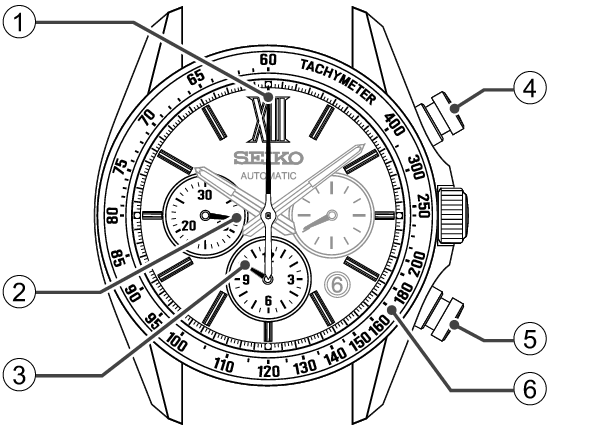
Before using the tachymeter, confirm your watch has a working chronograph with start, stop, and reset functions. Most tachymeter scales sit on the bezel or outer dial, ranging from 60 to 500 units per hour.
Pick a known distance for accurate measurement. One mile or one kilometer works best. Use highway markers, racetrack segments, or GPS-verified stretches of road. Accuracy matters because any error in your distance directly affects your final speed reading.
Start Timing at the Beginning
As your vehicle or the object passes the starting point, press the top pusher to start the chronograph. The central seconds hand jumps into motion from the 12 o’clock position. Practice your timing with consistent cues, such as when the front of your car passes a specific line. Even a one-second delay can skew results, especially at high speeds.
Stop the Timer at the End Point
Once the object reaches the end of your measured distance, press the top pusher again to stop the chronograph. Watch where the seconds hand lands on the tachymeter scale. That number is your average speed in units per hour, assuming you measured exactly one mile or one kilometer.
Understand the 60-Second Limit
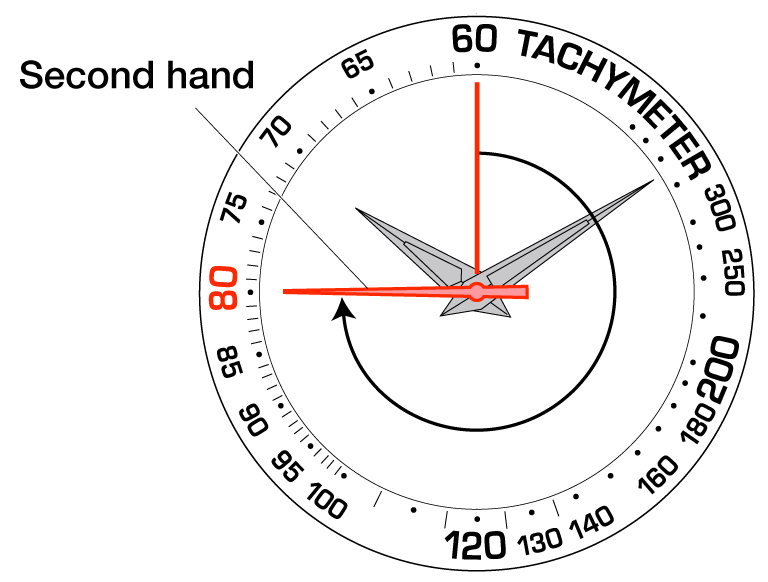
The tachymeter only works directly for events lasting 60 seconds or less. If your timing exceeds a minute, the seconds hand passes the tachymeter scale and a direct reading becomes impossible.
For example, if a car covers one kilometer in 45 seconds, the chronograph hand points to 80 on the tachymeter scale, giving you an average speed of 80 km/h. This works because 3600 seconds divided by 45 equals 80. If the same car took 75 seconds, the hand would be past the 60-second mark with no direct reading available.
Workarounds for Longer Events
When timing exceeds 60 seconds, use fractional distances and divide the tachymeter reading accordingly. Alternatively, use multiple units and multiply the reading. For very slow objects like runners, measure a shorter distance like 0.1 mile and divide your reading by 10 to get your pace.
Read Speed from the Tachymeter Scale
With the chronograph stopped, read where the seconds hand points on the tachymeter scale. That number represents your average speed in units per hour. The numbers increase counterclockwise from 60 to 400 or 500, matching the clockwise sweep of the seconds hand.
Tachymeter Reference Table
The tachymeter uses a logarithmic scale pre-calculated using the formula: Speed equals 3600 divided by time in seconds. Here are common readings:
At 60 seconds, the reading is 60. At 45 seconds, it reads 80. At 36 seconds, it shows 100. At 30 seconds, it points to 120. At 20 seconds, it reads 180. At 15 seconds, it shows 240.
No math is needed during use. Simply read the number where the hand stops and you have your speed.
Measure Speeds Beyond the Standard Scale
Multiple Distance Units
The tachymeter assumes a one-unit distance, but you can measure faster speeds by timing multiple miles or kilometers. Use the formula: Speed equals tachymeter reading multiplied by the number of units.
For example, if you drive two miles in 40 seconds and the chronograph stops at 90 on the tachymeter, multiply 90 by two for a reading of 180 mph. This method lets you measure very high speeds like aircraft or race cars by increasing your base distance.
For an aircraft, track it over 10 miles with an elapsed time of 20 seconds. The tachymeter reads 180, so multiply by 10 for an actual speed of 1800 mph.
Fractional Distances
For slower objects like runners or cyclists, use a fraction of a mile or kilometer and divide accordingly. If you run 0.1 mile in 30 seconds and the tachymeter reads 120, divide by 10 to get 12 mph. Always use measured distances rather than visual estimates for accuracy.
Measure Heart Rate and BPM
Since the tachymeter calculates events per hour, it can estimate beats per minute. Start the chronograph on one heartbeat and stop on the next beat. Read the tachymeter value and divide by 60 to get BPM.
For example, one heartbeat cycle taking 1.5 seconds gives a tachymeter reading of 2400, divided by 60 equals 40 BPM.
Shortcut for Faster Rhythms
Time 15 beats and multiply the tachymeter reading by four to get BPM. Note that most tachymeters max out around 500, making them best suited for fast rhythms like music or machinery rather than slow human pulses.
Track Machine and Task Output
Use the tachymeter to measure production rates or task frequency. Watch a machine dispense a part and start the chronograph at Part 1, stopping at Part 2. The tachymeter reading equals units per hour.
For example, 12 seconds between parts gives a reading of 300, meaning 300 parts per hour output.
Faster Processes
For very fast processes under eight seconds where readings exceed the scale, count multiple events. Time five parts and stop the chronograph after the fifth. Multiply the tachymeter reading by five. If five parts take 30 seconds and the hand points to 120, multiply by five for 600 parts per hour.
This technique works for typing speed, web server requests, repetitive manual tasks, and assembly line throughput.
Avoid Common Measurement Errors
Several mistakes can lead to inaccurate readings. Using mph markers while reading km/h or vice versa gives completely wrong results. Always confirm whether your measured distance is in miles or kilometers and match your tachymeter accordingly.
Poor reaction timing adds significant error. Practice starting and stopping with consistent cues. Tachymeters measure average speed only, so acceleration or braking during your timing interval won’t reflect real-time speed. For best accuracy, use flat, straight roads with steady throttle.
Choose the Right Tachymeter Scale

Not all tachymeters are equal. Their minimum time determines maximum measurable speed. A 500-scale tachymeter lets you time faster events than a 240-scale model.
A minimum time of 7.2 seconds gives a maximum speed of 500, best for racing and aircraft. A minimum time of 9 seconds gives 400, suitable for general use. A minimum time of 15 seconds gives 240, typical for entry-level and vintage watches.
If your watch tops out at 240, you cannot directly measure anything faster than 15 seconds per unit without using multi-unit methods.
Recognize Historical and Modern Use
Tachymeters were essential tools in the 20th century. Race car drivers used models like the Rolex Daytona to time laps and verify speed between track markers. Pilots estimated ground speed between landmarks and calculated fuel burn rates using watches like the Breitling Navitimer. Engineers measured conveyor belt speed and monitored machinery cycles.
Today, GPS has replaced most functions, but tachymeters remain on iconic models like the Omega Speedmaster, TAG Heuer Carrera, and Timex Marlin. They now serve as functional art, connecting wearers to a legacy of precision engineering.
Frequently Asked Questions About Using a Tachymeter
Can I use a tachymeter on a non-chronograph watch?
No. A tachymeter requires a working chronograph function to operate. The scale measures elapsed time using the chronograph seconds hand, so a standard three-hand watch cannot provide tachymeter readings.
What if my timing exceeds 60 seconds?
For events taking longer than 60 seconds, use fractional distances and divide your tachymeter reading accordingly. Alternatively, measure multiple units within 60 seconds and multiply the reading by the number of units.
Does the tachymeter measure miles per hour or kilometers per hour?
The tachymeter itself does not specify units. It displays units per hour, so if you timed one mile, it reads mph. If you timed one kilometer, it reads km/h. Always match your distance unit to your desired speed unit.
Can I use a tachymeter while driving safely?
Using a tachymeter while driving requires a passenger to operate the chronograph. Attempting to start and stop the timer while driving creates a serious safety hazard. Always have a passenger handle timing or practice in a safe stationary environment.
Why do some tachymeters go to 500 while others stop at 240?
The maximum scale depends on the watch design. Higher-end chronographs often feature 500-scale tachymeters for measuring faster events. Entry-level models typically max out at 240, limiting direct readings to speeds above 15 seconds per unit.
Is a tachymeter still useful in the GPS era?
While GPS provides more precise measurements, the tachymeter remains useful as a backup tool, a functional conversation piece, and a way to connect with horological history. It’s also excellent for educational purposes and creative applications like measuring task output.
Key Takeaways for Mastering Your Tachymeter
The tachymeter transforms your chronograph from a simple timekeeper into a mechanical calculator capable of measuring speed, distance, and rates. Remember that it works best for events under 60 seconds and requires a known distance of exactly one mile or one kilometer for direct readings. Adjust your calculations for multiple units or fractional distances to expand its versatility.
Practice makes perfect. Start with highway driving where mile markers provide clear reference points, then experiment with heart rate and machine output measurements. The more you use your tachymeter, the more intuitive it becomes. Your watch is more than a timepiece. It’s a functional tool with a rich heritage of precision engineering sitting right on your wrist.