You’ve always admired the intricate dance of gears inside a mechanical watch. The ticking second hand, the smooth sweep of the minute hand, the quiet pride of wearing something you built. It is more than a timepiece. It is a statement. But when you search how to make a watch, you are met with conflicting advice. Is it machining every gear from raw steel? Or just assembling a kit? The truth lies in between.
Making a watch today means designing and assembling your own timepiece, not from raw ore, but from precision components. With DIY kits, off-the-shelf movements, and custom parts, you can create a truly unique mechanical watch without a million-dollar workshop. Whether you are a beginner or an aspiring microbrand, this guide breaks down exactly how to make a watch, step by step, using realistic, proven methods.
Choose Your Watchmaking Path
There are three practical levels of making a watch, each matching your skills, tools, and goals.
Start with a DIY Watch Kit
If you have never touched a movement, begin with a complete DIY kit. Brands like DIY Watch Club and Rotate Watches offer everything you need. You get the movement, dial, hands, case, tools, and video guides. You will build a working mechanical watch in 2 to 3 hours, and no experience is required.
Best options for beginners include Rotate’s Cabot or Marco kits, which cost $255 and include Seiko NH35 movements, premium dials, and full support. DIY Watch Club offers the Brown Bag Kit at $179, which includes tools and components.
Modify a Standard Movement
Once you have assembled a kit, upgrade to customization. Swap dials, hands, and cases on proven movements like the Seiko NH35 or Miyota 8215. This is how most microbrands operate, using reliable, affordable base movements with unique designs.
Pro techniques include polishing screw heads, beveling bridges, or skeletonizing the movement for a high-end look. These small changes transform a standard movement into something special.
Build Custom Components (Advanced)
If you have a CNC mill or lathe, fabricate your own cases, crowns, or dials. Some artisans even machine movement plates or create complications. However, do not expect to forge a hairspring at home. Escapements require cleanrooms and proprietary alloys.
Full scratch-building is a lifelong pursuit. Even master watchmakers often source movements rather than forge every component from raw metal.
Essential Tools for Watch Assembly
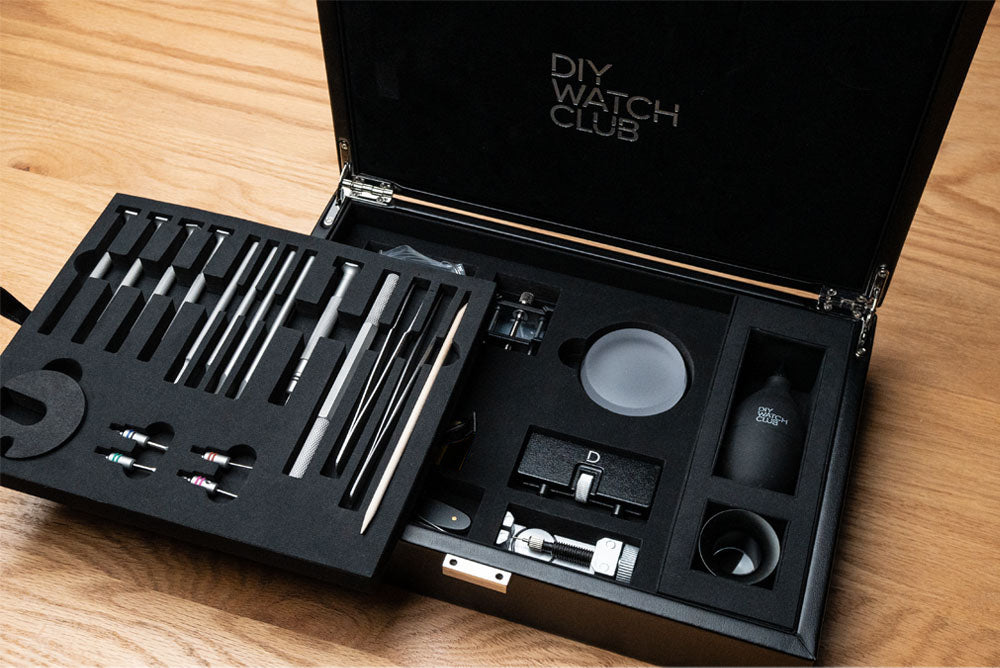
You do not need a full machine shop to start. Here is what you actually need for kit assembly and basic modding.
Must-Have Tools
These tools form the foundation of every watchmaker’s workshop.
• Soft work mat. Protects the movement. Choose one with a center dimple.
• Precision tweezers. Handle tiny parts. Use anti-magnetic varieties.
• Magnifying loupe (3x to 10x). See small components. Headband or handheld works.
• Hand press tools. Install hands safely. Different tips for different sizes.
• Air blower. Remove dust. Camera-style blowers work best.
• Finger cots. Prevent oil transfer. Wear on thumb and index.
• Case back wrench (JAXA). Open screw-down backs. Essential for water resistance.
• Pin vise and side cutter. Trim stems for crown fit.
• Dial protector. Shield during assembly. Plastic or metal shield.
Budget tip: Buy a DIY Watch Club Brown Bag Kit at $179. It includes tools and components. Avoid the $279 Pro version because it is overpriced for what you get.
Step-by-Step: Assemble a Watch from a Kit
Follow these steps to build your first mechanical watch using a DIY kit.
Prepare Your Workspace
- Clean the surface. No fans, no dust.
- Wear finger cots. Skin oil ruins finishes.
- Lay out tools and parts on a soft mat.
- Use air blower. Remove dust before touching components.
Pro tip: Work under good lighting with a magnifier. A shaky hand can bend a hand or scratch a dial.
Disassemble the Case
- Insert inflatable rubber ball into the case back.
- Pull to release the back. Do not pry.
- Remove O-ring, clean it, and apply silicone gasket lubricant.
- Press the small dent near the crown to release the movement holder.
Warning: Dust inside the case can stop the movement. Clean thoroughly before proceeding.
Set and Attach the Dial
- Set the date using the crown. Align to midnight position.
- Align dial feet with movement posts.
- Gently press the dial down until it clicks.
- Remove excess pins. Only top and bottom should remain.
Caution: Never touch the dial surface. Use tweezers only on the edges.
Install the Hands
This is the most delicate step. Use the correct hand press tool, not tweezers.
Hour Hand: Angle slightly, press onto cannon pinion. Use 1.0mm press tip, press until soft click.
Minute Hand: Align with hour hand post. Press gently with 1.5mm tip.
Second Hand: Most fragile. Align pin with center shaft. Press lightly. Too much force bends it.
Pro tip: Use a dial protector to avoid scratching the dial during pressing.
Trim the Stem (If Needed)
Some crowns sit too high. Trim the stem to fit.
- Measure 15.15mm from the end (standard for most cases).
- Mark with a Sharpie.
- Secure stem in pin vise.
- Cut with precision side cutter.
- Sand edges with 400-grit paper.
- Test fit. Trim in small increments.
Avoid: Cutting too much. You cannot add length back.
Reassemble the Case
- Reinstall lubricated O-ring.
- Align case back, twist clockwise.
- Use JAXA wrench for a quarter to half turn.
- Do not over-tighten. It makes future disassembly hard.
Water resistance tip: A properly sealed O-ring and screw-down back can make your watch 100m water resistant.
Attach the Strap
- Match lug width (for example, 20mm).
- Use spring bar tool. Insert into lug holes.
- Start with buckle end, then crown end.
- Try yacht-sail fabric straps. They offer luxury feel at an affordable price.
Design secret: A $20 strap can make a $200 watch look like $2,000.
Flame-Bluing Hands (Advanced Finish)
Add luxury flair with flame-blued hands, a technique used in high-end watches.
What You Need
• Small torch
• Brass filings tray (color indicator)
• Distilled water (for quenching)
• Practice hands
Process
- Heat hand evenly over flame.
- Watch color change. Light turns to purple, then blue, then gray.
- Remove at iridescent blue stage.
- Immediately quench in water.
- Repeat if overheated (turns gray).
Warning: Overshooting ruins the temper. Practice on spare hands before working on your actual watch.
Note: Cameras often underrepresent the true metallic sheen of flame-blued hands.
Recommended Movements for Custom Builds
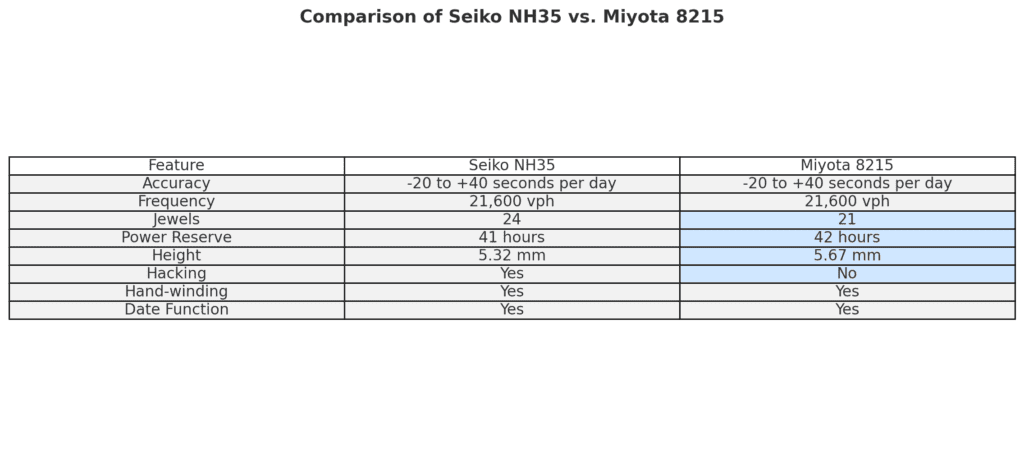
The movement is the heart. Choose wisely.
| Movement | Origin | Features | Best For |
|---|---|---|---|
| Seiko NH35/NH36 | Japan | Automatic, hacking, hand-wind, 41h power reserve | Beginners, modders |
| Miyota 8215 | Japan | Automatic, 40h power reserve | Budget builds |
| Sellita SW200 | Switzerland | ETA 2824 alternative | Premium microbrands |
| Seagull ST3600 | China | Automatic, hacking | Learning servicing |
Avoid: Counterfeit movements. They have poor fit and inconsistent timekeeping.
Build Your Own Case (CNC Method)
For full customization, machine your own case.
Tools Needed
• 3-axis CNC mill
• CAD software (Fusion 360, SolidWorks)
• Stainless steel or titanium blanks
Steps
- Design case in CAD. Include lug width and case back threads.
- Generate toolpaths in CAM software.
- Mill from solid block. Use coolant to prevent heat warp.
- Finish with polishing. Mirror or brushed finish.
Real example: Brooklyn artisan used railway steel and forklift wheel cast iron to build his CNC rig. He machined the entire case, crown, and dial by hand.
Cost: Build vs. Kit vs. Knockoff
| Option | Cost | Quality | Notes |
|---|---|---|---|
| AliExpress DIY Build | ~$110 | Low | Inconsistent parts |
| Rotate Kit (Cabot) | $255 | High | Premium materials, support |
| DIY Watch Club (Brown Bag) | $179 | High | Best value for beginners |
| Custom CNC Case + Kit | $400+ | Unique | One-of-a-kind design |
Truth: A $179 kit feels like a $1,000 watch when you build it yourself.
Learn from the Masters
Essential Books
• Watchmaking by George Daniels. The bible of horology.
• The Theory of Horology. Technical foundation from WOSTEP.
Free Online Resources
• The Naked Watchmaker (the naked watchmaker.com). High-resolution movement teardowns.
• WristwatchRevival (YouTube). Servicing guides.
• NSy5qoxqP0k (YouTube). Step-by-step builds.
Inspirational Builders
• Don Corson. Documents full scratch builds.
• David Lowinger. Combines CNC and traditional techniques.
• Machiel Hulsman. Built a tourbillon from scratch.
Realistic Watchmaking Timeline
0 to 6 Months: Learn the Basics
• Buy a Rotate Cabot or DIY Watch Club kit.
• Assemble your first watch.
• Practice stem trimming and hand installation.
• Join Reddit r/Watches or DWC Forum.
6 to 24 Months: Level Up
• Buy broken watches on eBay. Practice servicing.
• Customize dials and hands.
• Learn hand-finishing (polishing, engraving).
• Explore CAD and CNC design.
2+ Years: Create Your Own
• Design custom complications (moonphase, power reserve).
• Machine simple gears or levers.
• Launch a microbrand or limited run.
Warning: Never start with an heirloom watch. Practice on junk first.
Final Tips from the Watchmaking Community
Start Small
Do not aim for a tourbillon. Begin with a Seiko NH35 kit. Master the basics before attempting complex complications.
Collect Tools Gradually
Start with tweezers, loupe, and hand press. Add more tools as you grow and tackle advanced projects.
Practice on Junk Watches
Buy non-running Seiko 5s on eBay for $20. Disassemble, clean, reassemble. This builds skill without risking valuable pieces.
Join Communities
• Rotate Watches Forum
• DIY Watch Club Community
• YouTube comment sections. Real builders help each other.
Embrace Failure
You will bend a hand. You will over-tighten a case back. Every mistake teaches you something valuable.
Have fun. Do not worry about getting ahead of yourself. There is so much joy in making your own case, finishing a movement, or designing a dial.
Frequently Asked Questions About Making a Watch
Can I really make a watch at home without prior experience?
Yes. Complete DIY watch kits from brands like Rotate Watches and DIY Watch Club are designed for beginners. No prior experience is required. You receive all components, tools, and step-by-step video guides. Most people complete their first watch in 2 to 3 hours.
How much does it cost to make a watch?
A basic DIY watch kit costs between $179 and $255. This includes the movement, dial, hands, case, and tools. Budget builds using AliExpress parts run around $110, but quality control is inconsistent. Custom CNC cases add $200 or more to the total.
What tools do I need to build a watch?
Essential tools include a soft work mat, precision tweezers, magnifying loupe, hand press tools, air blower, finger cots, case back wrench, pin vise, and dial protector. A complete kit like the DIY Watch Club Brown Bag ($179) includes most tools you need to start.
How long does it take to build a watch?
First-time builders typically need 2 to 3 hours to assemble a complete kit. Experienced watchmakers can complete the same kit in under an hour. Custom modifications or advanced finishing techniques add several more hours.
Can I customize the watch after building it?
Yes. After mastering basic assembly, you can swap dials, hands, and cases. You can also learn hand-finishing techniques like polishing, beveling, and flame bluing. Advanced builders use CNC machines to fabricate custom cases and dials.
Is it worth making your own watch?
Absolutely. The value goes beyond the timepiece itself. You gain deep appreciation for horology, develop precise hand skills, and create something truly unique. A watch you built yourself carries meaning that a store-bought piece cannot match.
Key Takeaways for Building Your First Watch
Making a watch is more accessible than most people realize. You do not need a factory or expensive equipment. You need a quality kit, some basic tools, and patience.
Start with a DIY watch kit from Rotate or DIY Watch Club. These provide everything you need, including instructions. Your first build will take 2 to 3 hours, and you will have a functioning mechanical watch to wear.
From there, the path branches in many directions. You can modify movements with custom dials and hands. You can learn advanced finishes like flame bluing. You can even CNC-machine your own case. Each step builds on the last.
The watchmaking community is welcoming and helpful. Join forums, ask questions, and practice on inexpensive watches before touching anything valuable. Every expert was once a beginner.
The gears are waiting. Start turning them. Your first watch is closer than you think.