You’ve just inherited a vintage Waltham pocket watch, and you’re eager to see what’s inside. Maybe you want to check the serial number, assess its condition, or simply admire the intricate movement. But how do you open it without damaging a family heirloom? Many owners mistakenly force the back open or pry at the wrong spot, risking broken hinges, stripped threads, or scratched cases. The truth is, Waltham pocket watches use multiple case types, each requiring a specific opening method. Get it wrong, and you could cause permanent damage. The good news? With the right knowledge, opening your Waltham is simple, safe, and satisfying. This guide walks you through every step from identifying your case type to accessing the movement, using only the tools you likely already have.
Identify Your Case Type First
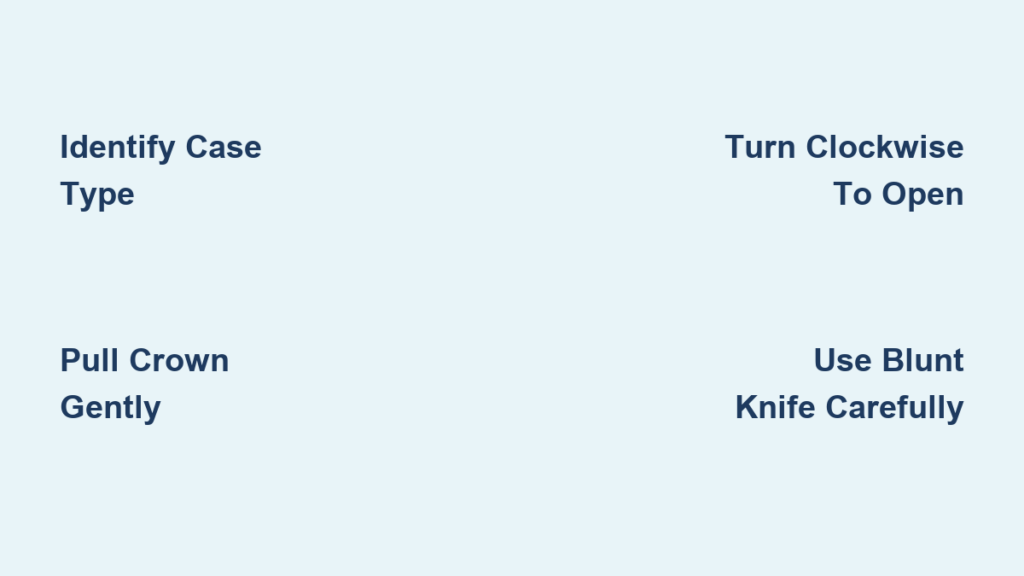
Before touching any tool, you must determine which type of case your Waltham uses. Applying the wrong method can bend hinges, strip threads, or crack the crystal. Walthams were made with five primary case styles, but four are most commonly encountered today. A quick visual inspection is all it takes.
Check for a Swing-Out Movement
If your Waltham has no visible seams, screws, or notches on the back, it likely uses a swing-out (hinged movement) case. This is the most common design for American-made Walthams from the late 1800s to early 1900s. In this design, the entire movement pivots out from the front after the crown is pulled. There is no removable back. The crown is at 3 o’clock, and the case appears solid. Do not attempt to pry or unscrew the back. Instead, focus on the crown: gently pull it outward until you feel a click. That releases the movement.
Pro Tip: A confirmed 1884 William Ellery model used this system. One user reported: “Once the crown was pulled outward, the movement swung free.” No tools required.
Look for Reverse-Threaded Screw Backs
If the case back has a smooth edge with no pry points but shows engraved markings around the rim, it may be a screw-back model. Here’s the critical detail: it unscrews clockwise, not counterclockwise. This reverse threading is standard on many Waltham screw-back cases. Attempting to turn it the wrong way can strip the threads permanently.
To test, hold the watch firmly and rotate the back to the right (clockwise). Use a soft cloth for grip if needed. If it resists, don’t force it. Place the watch face-down on a padded surface and rotate the case body while holding the back steady with your palm.
Warning: Never assume standard threading. Forcing counterclockwise can ruin the case permanently.
Spot the Hinged Back with Cuvette
Some high-grade or railroad-era Walthams feature a two-stage opening system. The outer back hinges open like a lid, revealing an inner dust cover called a cuvette. This second layer protects the movement from dust and moisture.
Look for a visible hinge at the 6 o’clock position on the back. Once opened, inspect the inner cover for a thin slit near 2 o’clock. This is where you insert a case knife. A magnifying glass helps spot micro-scratches from previous openings, which often mark the correct entry point.
User Confirmation: One collector noted, “Upon closer re-examination, I do see a second hinge beneath the outer one. Just need an opener to pry the back.”
Find Snap-Back Case Seams
Snap-back cases are less common on premium Walthams but appear on lower-cost or reproduction models. These backs pop off with light pressure, usually at a small notch or indentation around the edge.
Look for a thin, continuous seam circling the case. If you see a tiny gap or dimple, that’s your insertion point. Use a case knife or even a fingernail to apply even upward pressure. Avoid twisting or prying unevenly. This can warp the case and make reassembly difficult.
Alternative Method: If the back is tight, try a small suction cup for grip, as one user successfully did.
Open Swing-Out Cases Safely
Swing-out (or swing ring) cases are the most frequently encountered in vintage Walthams. Since the movement exits from the front, there’s no need to remove the back. This design protects the case from wear but requires careful handling of the stem and hinge.
Pull the Crown to Release
Start by pulling the crown outward gently, just until you feel a distinct click. This disengages the square end of the stem from the movement. Do not yank or pull hard. Excessive force can break the stem or damage the setting mechanism.
Once released, the movement is free to pivot. The hinge is located at the top (12 o’clock), so lift from the bottom (6 o’clock) side. The movement should swing out smoothly, like a door on a hinge.
Expert Warning (Kevin W., NAWCC Member): “Sure glad you did not pull hard or you may have broke the stem.”
Lift the Movement from 6 O’Clock
With the crown pulled and clicked, use your fingers to gently lift the movement upward from the 6 o’clock area. Apply even pressure. Don’t twist or tilt. The movement should pivot freely on its upper hinge.
If it resists, double-check that the setting lever is fully retracted. As Jerry Treiman (NAWCC Fellow) advises: “Make sure the setting lever is all the way in before you attempt this or you may damage it.”
Once open, you’ll have full access to the movement for inspection, cleaning, or servicing.
Reassemble Without Damage
To close, align the square hole on the movement with the stem. Gently push the movement back into place until it seats fully. Then, push the crown back in to re-engage the stem. You may need to wiggle the crown slightly to catch the square.
Ensure the movement is flush with the case before closing the front bezel (if applicable). For watches with screw-on bezels, turn counterclockwise to tighten. This is standard threading.
Note: One user reported lifting the movement “straight out by the stem,” suggesting rare press-fit variants. But unless you confirm no hinge exists, always assume a swing-out design.
Remove Screw-Back Cases Correctly

Screw-back Walthams are often higher-grade models with a clean, elegant appearance. But their reverse threading catches many beginners off guard. Turning the wrong way won’t just fail. It can destroy the threads.
Turn Clockwise to Open
Hold the watch body firmly in one hand. With the other, grip the back and rotate it clockwise (to the right). Yes, this loosens it, not tightens. This reverse threading is intentional and common on Waltham screw-back cases.
If it’s stiff, place the watch face-down on a soft cloth. Use your palm to hold the back while rotating the case body counterclockwise with your other hand. This gives better leverage without risking damage.
User Experience: “The back of the watch should twist off with gentle pressure.” Confirmed by multiple expert interactions.
Inspect for a Dust Cover
Once the back is off, check for an inner cuvette. This is a secondary dust cover that may need removal. If present, it will have a small gap or slit, usually near 2 o’clock. Use a blunt case knife to gently pry it open.
Avoid sharp tools. Plastic or nylon prying tools prevent scratches. This inner cover protects the movement, so handle it carefully.
Reattach with Even Pressure
To reassemble, align the threads carefully. Start turning counterclockwise to engage. This tightens the reverse thread. Once seated, tighten gently by hand. Over-tightening can deform the case or make future opening difficult.
Pro Tip: If the back feels cross-threaded, back off and restart. Never force it.
Open Hinged Backs with Cuvettes
High-quality Waltham models, especially railroad-grade watches, often use a dual-layer protection system. An outer hinged back and an inner cuvette keep dust and moisture away from the delicate movement.
Open the Outer Back First
Locate the hinge at 6 o’clock on the case back. Gently lift the outer cover upward. It should swing open smoothly on its hinge. If stiff, don’t force it. Check for debris or corrosion.
Once open, you’ll see the inner cuvette covering the movement. This layer is usually held in place by a press fit and requires prying to open.
Locate the 2 O’Clock Pry Point
Examine the inner cover closely. Use a magnifying glass or 10x loupe to find a slit or gap, typically near the 2 o’clock position. This is the designated entry point.
Do not guess. Prying at random spots can scratch or crack the cuvette. Previous openings often leave micro-scratches that mark the correct spot.
Tip: One user confirmed: “Just need an opener to pry the back open” after spotting the second hinge.
Pry Gently with a Blunt Knife
Insert the tip of a blunt case knife into the slit. Apply gentle, upward pressure. No twisting or leverage. The cuvette should pop free with minimal force.
If it resists, stop. It may be stuck due to age or corrosion. In such cases, consider professional help rather than risking damage.
Precaution: Use plastic or nylon tools if available. Metal can scratch gold-filled or silver cases.
Handle Snap-Back Cases with Care
Snap-back cases are simpler but still require caution. These backs are held by a spring fit and can warp easily if pried unevenly.
Insert Tool at the Notch
Find the small indentation or notch around the case edge. This is where you insert your tool. A blunt case knife works best, but a fingernail can suffice on loose-fitting cases.
Insert the tip just enough to catch the lip. Don’t jam it deep. This can scratch the case interior.
Apply Even Upward Pressure
Lift straight up with steady, even pressure. Avoid twisting or rocking the tool. The back should release uniformly around the rim.
If it doesn’t budge, try another point opposite the notch. Sometimes pressure builds unevenly.
Alternative: Use a small suction cup on the back for grip, as suggested by user AEMitch. This avoids metal contact entirely.
Reassemble with Alignment
To close, align the seam perfectly. Press around the edge with even pressure. Don’t slam it shut. A warped snap-back won’t seal properly and may rattle or fall off.
Warning: Once deformed, snap-back cases are hard to repair. Handle with care.
Use the Right Tools Only
Most Waltham openings require minimal tools. Using the wrong ones like screwdrivers or pliers can scratch, dent, or break components.
Blunt Case Knife for Prying
A blunt case knife is essential for hinged and snap-back models. Never use a sharp blade. This can gouge metal or slip into delicate parts.
Plastic or nylon alternatives are safer for gold-filled or silver cases.
Magnifier for Precision
A 10x loupe or magnifying glass helps identify seams, hinges, and pry points. Many cuvettes have nearly invisible gaps. Without magnification, you might damage the wrong spot.
Pro Tip: Inspect the back under bright light. Reflections often reveal hidden seams.
Soft Cloth for Grip
When removing screw-back cases, a soft cloth or rubber pad improves grip without scratching. Place it over the back and twist clockwise.
Avoid rubber gloves. They can leave residue.
Avoid Common Tool Mistakes
- No screwdrivers for prying. Too sharp and rigid.
- No pliers on the case. Can crush or mar surfaces.
- No excessive force. If it resists, recheck the method.
Expert Insight: “Use minimal force. Waltham cases are delicate. Damage is often irreversible.”
Find the Real Serial Number
Once open, your next goal is likely identifying the watch. But don’t be fooled by case engravings. The true serial number is on the movement, not the case.
Locate Movement Engravings
Turn the movement over and look for engravings on the main plate. This is where Waltham stamped the serial number, grade, jewel count, and model.
For example, #18467639 decodes to:
* Year: 1912
* Grade: 625
* Jewels: 17
* Model: 1908
* Size: 16s
* Railroad Grade: No
Use PocketWatchDatabase.com to decode yours.
Expert Clarification: “That is a case inventory number. The serial number on a Waltham pocket watch is found on the movement.”
Ignore Case Numbers
Many cases have numbers like “905” or “14130554.” These are case manufacturer IDs, not production numbers. They identify the case maker (e.g., AWCO) or inventory, not the watch itself.
One user had “905” on both case halves and movement. This is likely the case serial, not the movement number.
Assess Condition Before Winding
Before winding or touching the movement, check its basic function. A simple test reveals whether the balance staff is intact and the gear train moves.
Perform the Doorknob Twist Test
- Open the back and expose the balance wheel.
- Hold the watch dial-side down.
- Give it a sharp, rotating twist, like turning a doorknob.
- Watch the balance wheel:
* If it oscillates, the staff may be intact.
* If it doesn’t move, the movement could be seized, dirty, or broken.
Repeat the twist and watch the seconds hand (if present). Does it advance? If yes, the gear train is likely functional.
Test Winding Responsibly
If the balance moves, wind gently 4 to 5 turns. Listen for ticking. A healthy Waltham takes 16 to 20 turns to fully wind.
If the crown spins freely without resistance, the mainspring is likely broken. A broken spring may allow brief operation but won’t hold power.
Warning: Over-winding a damaged movement can worsen internal damage.
Know When to Call a Pro
Even with this guide, some situations demand expert hands.
Seek Help for Heirlooms or Value
If your Waltham is a family heirloom, rare model, or high-grade railroad watch, don’t risk DIY mistakes. One slip can reduce value or destroy irreplaceable parts.
Expert Advice (Jerry Treiman): “If you are unsure of yourself then let an expert do it.”
Consult for Rust or Seized Parts
Visible rust, dried oil, or seized components require professional cleaning and servicing. Attempting disassembly without proper tools can snap pivots or lose tiny screws.
When Reassembly Feels Uncertain
If you’re unsure how to re-engage the stem or seat the movement, stop. Misaligned parts can cause friction, wear, or complete failure.
Final Note: Improper handling often damages balance staffs, pivots, and mainsprings. These are the most delicate parts.
Frequently Asked Questions About Opening Waltham Pocket Watches
What tools do I need to open a Waltham pocket watch?
Most Waltham pocket watches can be opened with no tools at all. For hinged or snap-back cases, a blunt case knife and a 10x magnifying glass are helpful. Swing-out and screw-back models typically require only your fingers.
Why won’t my Waltham screw-back case open?
The most common mistake is turning the back counterclockwise. Waltham screw-back cases use reverse threading. You must turn clockwise to loosen. If it still won’t budge, place the watch face-down on a soft cloth and use your palm to hold the back while rotating the case body.
How do I know if my Waltham has a swing-out movement?
Look for a solid back with no visible seams, screws, or notches. The crown should protrude from the side at 3 o’clock. If you gently pull the crown outward and feel a click, you have a swing-out case. The movement will swing out from the front.
Can I damage my Waltham by opening it incorrectly?
Yes. Forcing the back open, prying at the wrong spot, or using the wrong threading direction can strip threads, bend hinges, scratch cases, or break the stem. Always identify the case type first before attempting to open it.
Where is the real serial number on a Waltham pocket watch?
The true serial number is engraved on the movement’s main plate, not the case. Case numbers like “905” or “14130554” are case manufacturer IDs. Use PocketWatchDatabase.com to decode the movement serial number.
Should I attempt to clean the movement myself?
No. Disassembling a watch movement requires specialized tools and training. Improper handling can damage delicate components like the balance staff, pivots, and mainsprings. For cleaning and servicing, consult a NAWCC-certified watchmaker.
Key Takeaways for Opening Your Waltham Pocket Watch
Opening a Waltham pocket watch is straightforward when you identify the case type first. The four main designs are swing-out (hinged movement), screw-back with reverse threading, hinged back with inner cuvette, and snap-back. Each requires a different approach, and forcing the wrong method can cause permanent damage. Always use minimal force, and stop if you encounter resistance.
The real serial number lives on the movement’s main plate, not the case. This number reveals the year, grade, jewel count, and model. Use PocketWatchDatabase.com to decode it. Case numbers are manufacturer identifiers and don’t determine the watch’s production date.
For heirlooms, rare models, or any watch with rust, seized parts, or uncertain reassembly, consult a professional watchmaker. Your watch’s history is worth protecting. When in doubt, let an expert handle it.