You’re scrolling through an online listing and spot a “genuine Rolex” at half the retail price. The photos look authentic. The seller promises it’s real. But something feels off. You are not alone. Counterfeiters fool millions of buyers every year with watches that look right but lack the precision of genuine craftsmanship. Learning how to tell if a Rolex is real or fake starts with understanding the details that only authentic Rolex engineering can produce.
This guide gives you the definitive checks used by professional authenticators. From serial number placement to movement precision, weight, and the micro-etched crown, every test is backed by Rolex manufacturing standards. Whether buying your first Rolex or verifying a vintage find, these steps will help you spot a fake before it’s too late.
Start by Verifying the Seller
Before examining the watch itself, confirm who you are buying from. Even the most convincing fake can be avoided by choosing the right source.
Trusted Sources for Buying Rolexes
You should only purchase from sources with proven track records and authentication guarantees. These include authorized Rolex dealers who offer factory-sealed watches with full warranty and digital registration. Certified pre-owned specialists like Bob’s Watches, Arnold Jewelers, and G&G Timepieces authenticate every timepiece they sell. Top-tier auction houses such as Christie’s, Sotheby’s, and Phillips provide expert appraisal and provenance verification.
Sources to Avoid Completely
Certain platforms carry too much risk for high-value purchases. Peer-to-peer marketplaces like eBay, Facebook Marketplace, and Craigslist offer no buyer protection and are saturated with counterfeits. Gray market sellers operating only online without a physical address or service history are also problematic. Private sellers offering steep discounts without documentation should raise immediate red flags.
⚠️ Even trusted platforms can host fakes. Always get independent verification.
Check Serial and Model Numbers

Rolex engraves serial and model numbers with precision laser technology. Their location and quality are critical authenticity markers that fakes rarely replicate correctly.
Where to Find the Numbers
The location depends on when the watch was produced. For models made before 2005, the serial number sits between the lugs at 6 o’clock, while the reference number is between the lugs at 12 o’clock. From 2005 to 2008, the serial appears both between the lugs and on the rehaut. After 2008, the serial is located only on the rehaut at 6 o’clock, requiring bracelet removal to see.
Signs of Genuine vs. Fake Engravings
Authentic Rolex engravings feature deep, sharp, diamond-cut edges with uniform font and spacing. They are laser-etched directly into metal, never stamped, acid-etched, or applied as stickers. Counterfeits often show shallow, dotted, or uneven engravings with misaligned text. Some fakes use stickers or printed labels instead of metal engraving, which is an immediate red flag.
Using Serial Number Verification Tools
Online tools like Bob’s Watches Serial Lookup, Rolex Tracker, and Chrono24 Authenticity Check can verify production year and flag inconsistencies. However, sophisticated counterfeits sometimes reuse real serial numbers. Always cross-check with a professional authentication.
Inspect the Dial and Hands
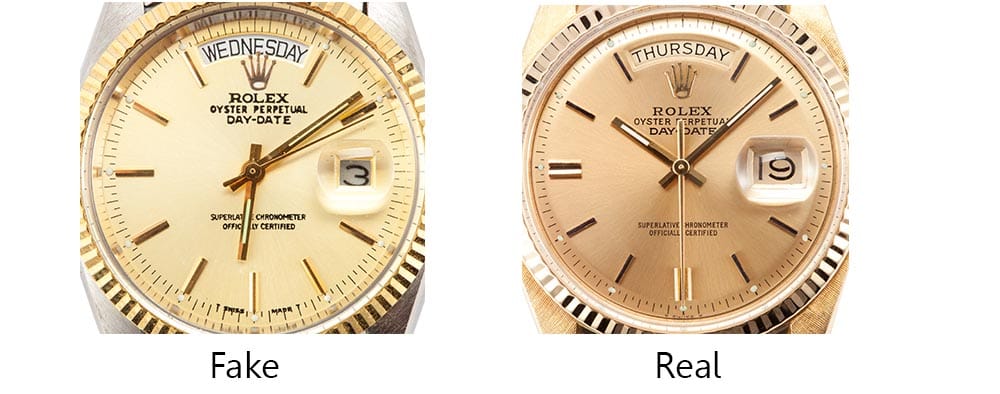
The dial is where many fakes fall short. Rolex uses proprietary fonts and finishing techniques that counterfeiters struggle to match.
Dial Details That Reveal Authenticity
Examine the “O” in ROLEX. It should be square, not rounded. The “Swiss Made” text must align perfectly with no offset or crooked placement. The crown logo should be perfectly centered with clean, symmetrical lines. Printing quality matters too. Authentic dials show crisp text with no smudging, bleeding, or halo effects around the letters.
Hands and Hour Markers
Genuine Rolex hands feature mirror-polished finishing with flawless shape. The Mercedes hand on Submariner models is a distinctive example. The lume, called Chromalight, glows blue in darkness with consistent coverage and no streaks. When the hands move, they should glide smoothly and align exactly with the hour markers.
Look for the Micro-Etched Crown

Introduced in 2002, the micro-etched crown is one of Rolex’s most effective anti-counterfeiting features.
What to Look For
A tiny crown logo is etched into the sapphire crystal at the 6 o’clock position. It measures approximately 1 millimeter in diameter. It is invisible to the naked eye and requires a 10x jeweler’s loupe to see. When viewed at the correct angle under magnification, it reflects light subtly. The etching is permanent and cannot be scratched off.
Why This Matters
Any Rolex made after 2002 without this micro-etching is automatically suspect. Most counterfeits lack this feature entirely. Super fakes may attempt to replicate it but typically get the size, depth, or placement wrong.
Examine the Rehaut Engraving
The rehaut is the inner ring between the dial and crystal. Since approximately 2005, Rolex laser-etches it with precision that fakes cannot easily replicate.
What Authentic Rehaut Shows
Genuine rehaut features display “ROLEX ROLEX ROLEX” text repeated around the entire ring. The serial number appears at 6 o’clock. The engraving is deep, clean, and evenly spaced. It is only visible with magnification or when viewing from side angles.
Counterfeit Rehaut Signs
Fakes often have missing text entirely. Some display “Rolex” only once instead of the repeated pattern. Shallow or misaligned engraving indicates a counterfeit. Some fakes attempt to print or stamp the rehaut rather than laser-etch it.
Test the Second Hand Motion
This test is simple but revealing. It takes seconds and can immediately flag many fakes.
How Real Rolex Movement Works
All modern Rolexes use mechanical automatic movements called Perpetual. These operate at 28,800 beats per hour, which equals 8 vibrations per second. The second hand advances in 8 micro-steps per second, creating the appearance of smooth motion rather than ticking. This is the famous “sweep” that Rolex owners recognize.
What Fake Movement Shows
Most counterfeit Rolexes use quartz movements. The second hand ticks visibly once per second. You can see the motion with your eyes and hear it in a quiet room. Some super fakes use stepper motors to mimic the smooth sweep, so this test is necessary but not foolproof.
Listen for the Ticking Sound
The sound a watch makes reveals its movement type.
What Silent Operation Means
A genuine Rolex is nearly silent. High-grade lubrication and precision engineering eliminate noise. Even in a quiet room held against your ear, you should hear no ticking.
Audible Ticking Indicates a Fake
If you can hear ticking when holding the watch to your ear, it likely contains a quartz movement or a low-quality mechanical clone. This simple test takes seconds in a silent environment.
Check the Cyclops Lens
The date magnifier is iconic and precisely engineered. It is one of the most copied features, but fakes rarely get it right.
Authentic Cyclops Features
The genuine Cyclops provides exactly 2.5x magnification. It is made from sapphire crystal, the same material as the main crystal. The lens has a convex bulge that rises seamlessly from the crystal with no visible seams, bubbles, or glue lines. It aligns perfectly with the date window.
Fake Lens Signs
Counterfeit lenses often provide flat or weak magnification, typically less than 2x or more than 3x. They may be made from plastic that scratches easily. Misalignment with the date window is common. Visible glue lines, bubbles, or seams around the lens indicate a fake.
Exceptions to Note
The Sea-Dweller Deepsea never has a Cyclops by design. The standard Sea-Dweller did not have Cyclops until 2017.
Inspect the Caseback
Modern Rolexes have solid, unadorned casebacks. This is a defining characteristic that fakes often get wrong.
What Authentic Casebacks Look Like
Genuine casebacks are solid metal, whether steel, gold, or platinum. They are smooth, fluted, or screw-down with no engravings, logos, or transparent windows. The finishing matches the case material precisely.
Red Flags for Casebacks
Exhibition or see-through casebacks showing the movement are not used by Rolex and indicate a counterfeit. Any engravings, logos, or decorative motifs are suspicious. Poor finishing, mismatched metal texture, or a loose fit are all warning signs.
Rare Exceptions
Some vintage ladies’ Datejust models from the 1970s and 1980s have “Stainless Steel” engraving. Special edition pieces like the 60th-anniversary Daytona may have exhibition backs, but these are extremely rare.
Weigh the Watch
Rolex uses premium materials that create substantial weight. A fake typically feels lighter due to hollow cases or base metals.
Expected Weights by Model
A genuine Submariner in steel weighs approximately 155 to 165 grams. The Datejust in steel runs 130 to 140 grams. A Daytona in gold exceeds 200 grams. The Deepsea weighs over 200 grams. Counterfeits typically weigh under 100 grams.
Why Weight Matters
The difference comes from genuine materials. Rolex uses 904L Oystersteel, which is denser and more corrosion-resistant than standard 316L steel. Solid 18k gold and 950 platinum add significant weight. Fakes use hollow cases or base metals that feel flimsy and light.
Examine the Crown and Clasp
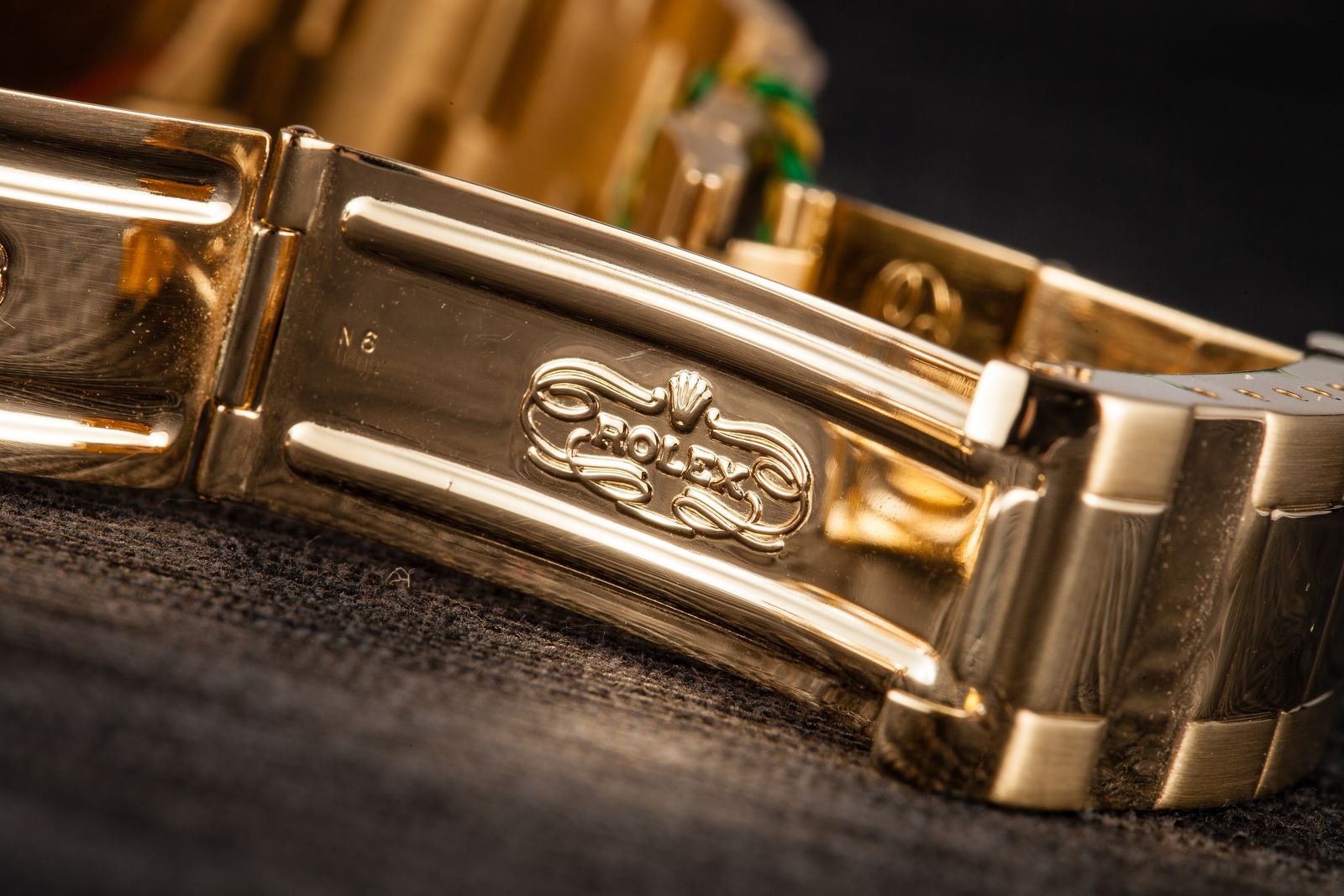
Small details matter. The crown and clasp reveal craftsmanship that counterfeitors cannot easily replicate.
Winding Crown Details
The crown must bear a sharply defined Rolex crown logo. It should be deeply engraved, not stamped or painted. The logo is perfectly centered and crisp. The screw-down action should be smooth with no wobble or looseness. Rolex uses Twinlock or Triplock systems depending on water resistance rating.
Bracelet and Clasp Quality
Genuine bracelets have solid links with no hollow construction. Clasps include Oysterlock, Crownclasp, or Easylink systems. Engravings are deep and include “Rolex” text and the crown logo. The clasp snaps shut with a firm, satisfying click. Shallow engravings, loose clasps, or hollow links indicate fakes.
Get Professional Verification
No matter how confident you are after these checks, professional authentication provides certainty.
Recommended Verification Steps
Use a 10x jeweler’s loupe to inspect micro-etching and engravings. Visit a Rolex-trained watchmaker for movement and case inspection. Consider video comparison services offered by specialists. Obtain an independent appraisal for watches valued over $5,000.
Why Professional Help Matters
Super fakes use advanced manufacturing but still lack Rolex’s exact finishing, tolerances, and balance. Only a trained professional can verify movement components through disassembly. Professional verification is the only guarantee of authenticity.
Frequently Asked Questions About Rolex Authentication
How can I tell if a Rolex serial number is real?
Genuine serial numbers are laser-etched with deep, sharp edges. They appear in correct locations based on production year. Fake serials are often shallow, dotted, or applied as stickers. Use verification tools and cross-check with professional databases.
Does a ticking second hand mean the Rolex is fake?
In most cases, yes. Modern genuine Rolexes have mechanical movements with smooth second hand motion. Audible ticking indicates a quartz movement, which is extremely rare in authentic Rolexes. Some super fakes mimic the smooth sweep, so this test alone is not definitive.
What does the micro-etched crown look like?
It is a tiny crown logo etched into the sapphire crystal at 6 o’clock. It is approximately 1mm in diameter and invisible without a 10x loupe. It reflects light subtly when viewed at the correct angle. Any Rolex made after 2002 should have this feature.
Are warranty cards and boxes proof of authenticity?
Not necessarily. Counterfeiters now replicate packaging and warranty cards. Original documentation supports authenticity but does not guarantee it. Always perform physical inspection regardless of paperwork.
How much should a genuine Rolex weigh?
Genuine Rolexes weigh between 100 and over 200 grams depending on model and material. A steel Submariner weighs approximately 155 to 165 grams. If a watch feels 10 to 15 percent lighter than expected, it is likely fake.
Key Takeaways for Authenticating a Rolex
Authenticating a Rolex requires examining multiple details working together. The serial and model numbers must be in correct locations with proper laser-etched quality. The second hand should sweep smoothly, not tick. The weight must feel substantial due to premium materials. The Cyclops lens provides exactly 2.5x magnification. The caseback remains solid and unmarked on modern models. The micro-etched crown appears on all Rolexes made after 2002. The rehaut displays repeated “ROLEX ROLEX ROLEX” text. Always verify the seller and get professional authentication before purchasing. These steps together provide confidence in your Rolex investment.