If your mechanical wristwatch has stopped ticking, the fix might be simpler than you think: it just needs a few turns of the crown. Winding a wrist watch properly is essential for keeping manual and automatic mechanical timepieces running accurately. Unlike quartz watches that rely on batteries, mechanical watches are powered by a tightly coiled mainspring that releases energy over time. Without regular winding or sufficient wrist motion for automatics, your watch will lose power and stop.
But how exactly do you wind a wrist watch without damaging it? Can you over-wind? And what is the right way to handle a screw-down crown or a destro model? Whether you are new to mechanical watches or looking to refine your routine, this guide delivers clear, step-by-step instructions based on technical precision and real-world best practices.
Remove Your Watch Before Winding
Always take the watch off your wrist before winding. Turning the crown while wearing it applies side pressure to the winding stem, which is a delicate component connecting the crown to the movement. This lateral stress can bend or damage the stem over time, especially in vintage or high-end models.
Place the watch on a soft, clean surface with the dial facing up. This protects the crystal from scratches and gives you a clear view of the hands if you need to reset the time afterward.
Pro Tip: Even a slight angle while winding can strain the stem. Hold the watch securely in your non-dominant hand and use your dominant hand to turn the crown smoothly.
Prepare the Crown Correctly
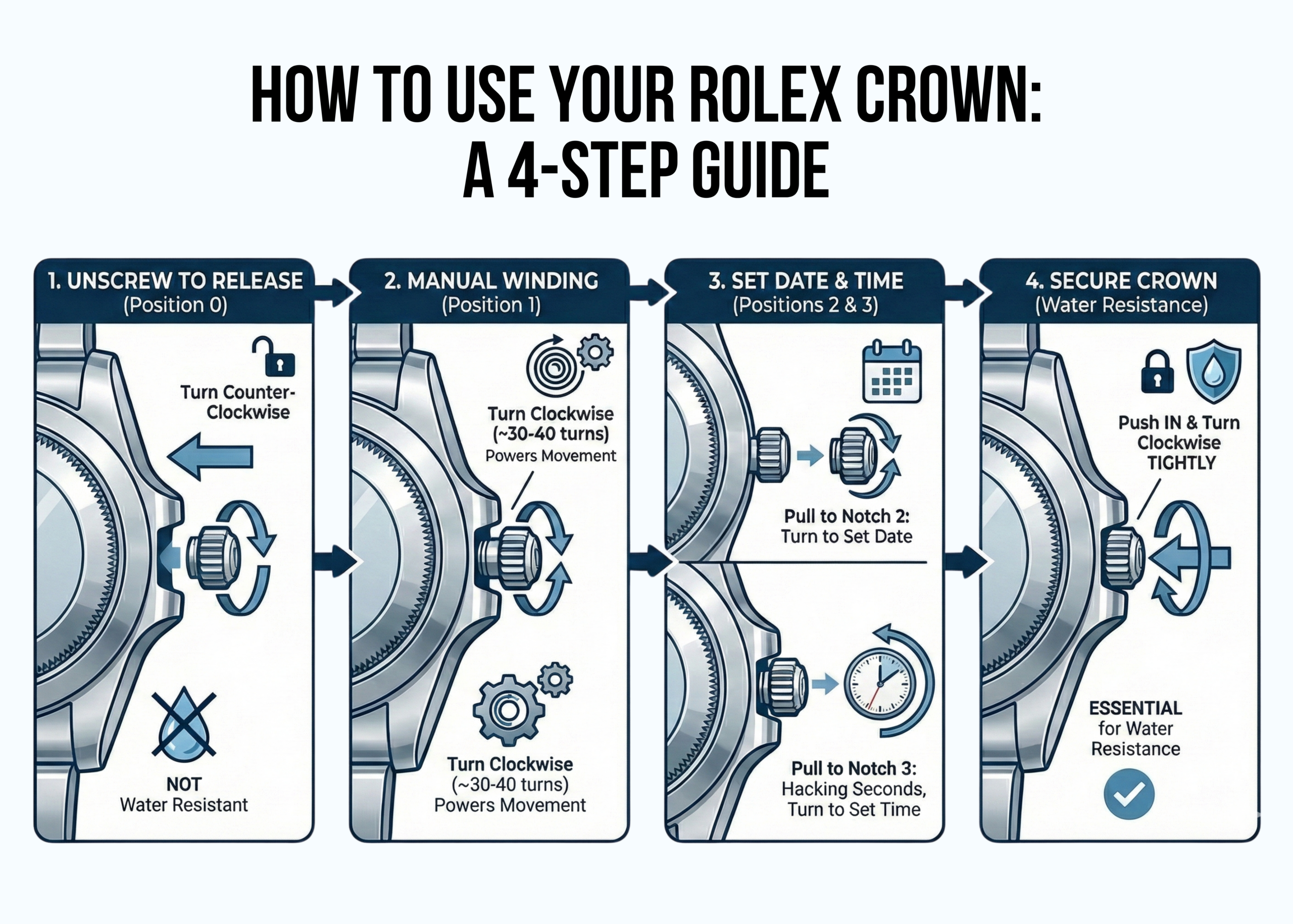
Locate the crown, typically positioned at 3 o’clock. Ensure the crown is in the first position, which is the winding mode. If your watch has a screw-down crown, you must unscrew it before winding.
Unscrew Screw-Down Crowns First
If your watch has a screw-down crown, turn it counter-clockwise gently until it pops out slightly. Do not force it; if there is resistance, check alignment. Common in dive watches like Rolex Submariners or Omega Seamasters, screw-down crowns require this extra step.
Once unscrewed, ensure the crown is pushed in fully. This is the first position for winding. Pulling it out further activates time or date setting functions. After winding, always push the crown back in and screw it down clockwise until snug. This maintains water resistance and protects the movement from dust and moisture.
Warning: Forgetting to re-screw the crown can lead to water ingress during swimming or showering, even if your watch is rated for 300 meters.
Turn the Crown Clockwise Only
Use your thumb and index finger to rotate the crown clockwise. This is the standard direction for engaging the winding mechanism in nearly all modern mechanical watches.
You will feel light resistance as the gears engage. Continue turning smoothly, typically 20 to 40 full rotations, until resistance increases significantly.
Why clockwise? Internal gearing is designed so only clockwise turns tighten the mainspring. Counter-clockwise rotation usually results in free spinning with no effect. It will not harm the watch, but it will not wind it either.
Exception: Some rare vintage or specialty movements may differ, but these are uncommon. When in doubt, consult your manufacturer’s manual.
Stop at Full Wind Resistance
As the mainspring tightens, resistance builds gradually. When you reach full wind, you will feel a firm stop or a slight slipping sensation. This is the slipping clutch disengaging, which is the watch’s built-in safety system.
Stop immediately. Forcing additional turns will not add more power and could damage the stem, crown, or internal gears, especially in older watches without modern safeguards.
Visual Cue: If the second hand starts moving smoothly again, you have likely restored enough power. But do not rely solely on this; feel matters most.
Re-Secure the Crown After Winding
Once done, gently push the crown back into place. For screw-down models, screw it in clockwise until tight against the case. Never leave the crown extended or partially unscrewed.
If you need to adjust the time or date, do this before re-securing the crown. Pull the crown to the second position for date or third for time, make adjustments, then return it fully and seal.
Critical Reminder: A loose crown compromises water resistance and exposes the movement to contaminants.
Wind Frequency by Watch Type

Manual-Wind Watches: Daily Routine
Most manual watches need daily winding, preferably at the same time each day, like every morning. This keeps the mainspring at optimal tension, ensuring consistent timekeeping.
Even models with 70-plus hour power reserves benefit from daily winding to maintain isochronal stability, which is the ability to keep accurate time across different power levels.
Tip: Wind before the watch stops. Letting it fully drain regularly is not harmful short-term, but consistent power improves performance.
Automatic Watches: Wind When Not Worn
Automatics self-wind through wrist motion. If worn daily for several hours, no manual winding is needed.
But if left idle for more than 24 hours, especially models with shorter reserves, wind it 20 to 40 turns to restart. You can also gently shake it side-to-side for 10 to 15 seconds to activate the rotor and generate initial power.
Example: A Rolex with a 48-hour reserve will stop after two days off the wrist. A quick wind brings it back to life instantly.
Can You Over-Wind a Watch?
Modern Watches: No, Thanks to Safety Clutch
Most mechanical watches made after the 1950s include a slipping clutch mechanism that prevents over-winding. Once the mainspring is fully tensioned, the gears disengage. Continued turning produces no additional tension, just free rotation.
So technically, you cannot over-wind the mainspring on a modern watch.
But do not ignore resistance. Forcing the crown after the stop can still damage the stem, crown, or crown tube, especially with repeated abuse.
Vintage Watches: Yes, Risk Is Real
Older watches, pre-1950s, often lack safety clutches. Over-winding can stretch or snap the mainspring, damage the barrel, or break the stem. Wind slowly and stop at the first sign of strong resistance.
Expert Note: If you own a vintage piece, consider having it inspected by a watchmaker to assess its winding safety.
How to Wind an Automatic Watch Manually
Yes, most automatic watches can and should be manually wound, especially when starting after inactivity.
Follow the same steps as manual watches. Remove the watch, unscrew the crown if applicable, turn the crown clockwise 20 to 40 times, feel for increasing resistance, stop when firm stop occurs, and re-secure the crown.
Myth Busted: Some believe automatics should not be hand-wound. This is false. Nearly all modern automatics support manual winding unless explicitly stated otherwise.
Exception: Certain chronograph movements or older designs may advise against it. Check your manual.
Destro Watches: Clockwise Still Applies
Destro watches have the crown on the 9 o’clock position instead of 3. Despite the reversed layout, winding direction remains clockwise.
The internal gear train is mirrored, but the functional rotation is unchanged.
Answer: Which way do I wind a destro watch? Clockwise, same as standard models.
Signs Your Watch Needs Winding
Watch for these early warnings. The second hand jumps 2 to 3 seconds at a time instead of moving smoothly. The watch runs slow or stops completely. The hand hesitates or stutters between ticks. These indicate low or depleted power reserve.
Note: A true mechanical sweep should be smooth. Jerky motion means low power.
Is It Bad to Let a Watch Stop?
Short-Term: No Problem
Letting a mechanical watch stop for days or even weeks is not harmful. Modern movements are built to handle periodic inactivity. Just wind it up when you plan to wear it again.
Long-Term: Risk of Oil Settling
If stored for months or years, lubricants can dry out or migrate, leading to increased friction upon restart. This may cause wear or timing issues.
Best practice for storage: Wind once every 1 to 2 weeks to keep oils circulating. Store in a cool, dry, dark place. Use a watch box or pouch. Avoid magnets and humidity.
Should You Use a Watch Winder?
A watch winder keeps automatic watches running when not worn by simulating wrist motion.
When It Helps
A winder is useful if you rotate multiple automatics, your watch has complex complications like perpetual calendar, you want watches ready to wear, or you own a display case and prefer seeing them run.
When It Is Unnecessary
A winder is not needed if you wear your automatic daily, you do not mind resetting the time occasionally, or the watch is not worn often enough to justify constant rotation.
Caution: Avoid 24/7 winding. Some experts recommend on/off cycles to mimic real use and reduce wear.
Important: Winders do nothing for manual-wind watches. They lack rotors and cannot self-wind.
Avoid Common Winding Mistakes
Here are the most common mistakes and how to avoid them.
Mistake: Winding on the wrist. This causes stem damage. Always remove the watch first.
Mistake: Forcing past resistance. This breaks the stem or spring. Stop when resistance peaks.
Mistake: Winding counter-clockwise. This has no effect. Only turn clockwise.
Mistake: Leaving screw-down crown open. This causes water ingress. Always re-screw tightly.
Mistake: Ignoring long stops. This leads to oil settling and inaccuracy. Wind stored watches weekly.
Pro Tip: Build a habit. Wind every morning with your coffee. It becomes second nature.
Frequently Asked Questions About Winding a Wrist Watch
Can you over-wind a modern mechanical watch?
No, modern mechanical watches have a slipping clutch that prevents over-winding. Once the mainspring is fully tensioned, the mechanism disengages. However, forcing the crown after resistance can still damage the stem or crown.
How many times should I turn the crown to wind my watch?
Most watches require 20 to 40 full rotations. Stop when you feel firm resistance or a slipping sensation. Do not count turns blindly; feel matters more than numbers.
Do automatic watches need manual winding?
Not if you wear them daily, as wrist motion generates power. But if you have not worn the watch for more than 24 hours, wind it manually for 20 to 40 turns to restart it.
Which direction do I wind a wrist watch?
Wind clockwise only. This is the standard direction for engaging the winding mechanism in nearly all modern mechanical watches. Counter-clockwise typically results in free spinning with no effect.
Can I damage my watch by winding it too often?
With modern watches, the slipping clutch prevents damage from over-winding. However, always stop when you feel resistance. For vintage watches without safety clutches, wind gently and stop at first resistance.
Does winding direction change for destro watches?
No. Despite having the crown on the right side, winding direction remains clockwise. The internal gearing is mirrored, but functional rotation does not change.
Key Takeaways for Winding Your Watch Correctly
Winding a wrist watch properly ensures accurate timekeeping and extends the life of your timepiece. Always remove the watch before winding to protect the delicate stem from lateral stress. Turn the crown clockwise only, typically 20 to 40 full rotations, and stop immediately when you feel firm resistance. For screw-down crowns, unscrew before winding and re-secure tightly afterward to maintain water resistance.
For manual watches, wind daily at the same time for consistent power. For automatics, manual winding is only needed after periods of inactivity. Vintage watches require extra caution since they lack modern safety clutches. Store unworn watches in a cool, dry place and wind them every week or two to keep lubricants circulating.
With these steps, your mechanical watch will run smoothly and reliably for years to come.